Rechercher

Onglets principaux

Résultats de la recherche

Nombre total de résultats : 127.

Linear Algebra III - part A

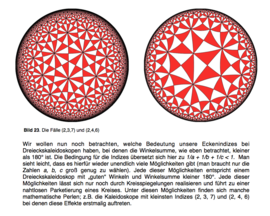
This digital publication is available in German and contains the lecture notes to a course given by Egbert Brieskorn in the 1980s at the University of Bonn. The central subject of the present volume is Euclidean geometry.

Please find part B of Linear Algebra III here.

Image: 
Contributor(s): 
Egbert Brieskorn
Andreas Beschorner
File(s) with Language: 

File title: 
Brieskorn LAIII-A

File language:

Linear Algebra III - part B

This digital publication is availbale in German and contains the unfinished last parts of lecture notes to a course given by Egbert Brieskorn in the 1980s at the University of Bonn, edited from the Nachlass. In these lectures Brieskorn merged modern presentations of Linear Algebra with topics of classical geometry more closely than usual at the time and probably also today. The central subjects of the present volume are the Theory of Polyhedra and Geometrical Crystallography. These subjects are presented in a way which is suited to build a passage from the introductory lectures on Linear Algebra to more demanding topics of mathematics and its applications.

Please find part A of Linear Algebra III here.

Image: 
Contributor(s): 
Egbert Brieskorn
Erhard Scholz
File(s) with Language: 
File title: 
Brieskorn LAIII-B

File language:

GANITA

Description

Description: 


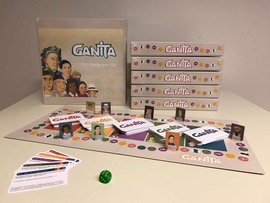
Ganita is an educational board game for the lower level of secondary school. Of course, it can also be played with family and friends at home. While moving along the board, the students have to solve exercises in five different categories covering the 2016 curriculum and problems from the mathematical world outside school. The different categories try to bear in mind various aspects to support students. Being physical and using embodied approaches, Ganita profoundly activates and engages the players. The exercises repeat and foster knowledge as well as they make the students apply their knowledge in different contexts. Thereby, they let the students recognize the relevance of mathematics in real life. The types of problems also support the use of creativity for problem solving and influence the student’s mathematical beliefs. The game mechanics require teamwork between students and help to motivate them in a strong and intrinsic way.


This version of the game is in German, translations to other languages are planned for the future.
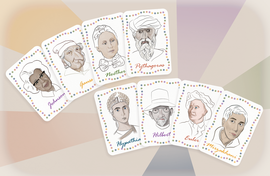
Information for translators: We welcome translations of the game in any languages. Feel free to add new mathematicians as pieces as well as to include their biography in the encyclopedia.

Criterias

Guidance needed?: 
no

Télécharger

Language:

Recommended Target Group:

Files: 
Title: 
Book for teachers PDF
Title: 
Legal Information Sticker PDF
Title: 
Printing Instructions PDF
Title: 
Online-Version
Title: 
Printing Instructions DOC
Title: 
Cards INDD
File: 
Title: 
Codes PDF
Title: 
Rulebook INDD
File: 
Title: 
Codes DOC
Title: 
Encyclopedia INDD
Title: 
Wissenschaftliche Arbeit
Title: 
Empty Cards
Main File: 
Main File Description: 
Gameboard - Cards - Pieces - Rulebook - Encyclopedia (all texts in German)
Credits Collection: 
Ganita was tested in cooperation with the German Mathematical Society.
Prof. Dr. Carla Cederbaum
Anja Fetzer
Prof. Dr. Carla Cederbaum
Dr. Elke Müller
Prof. Dr. Carla Cederbaum
Anja Fetzer
Lea Lange
Dr. Elke Müller
Prof. Dr. Carla Cederbaum
Dr. Elke Müller
Stephanie Schiemann
Michael Féaux
Olivia Vicanek Martinez
Image Collection: 

Exhibition/User:

Women of Mathematics throughout Europe

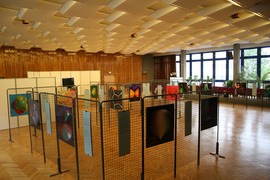
Thirteen women mathematicians portrayed in the original exhibition share their experience, thus serving as role models to stimulate young women scientists to trust their own strength. In presenting mathematics through women mathematicians’ perspectives and samples of their life stories, the curators hoped to highlight the human aspects of producing mathematics, making this discipline more tangible and therefore more accessible to outsiders or newcomers.

The format, originally envisaged as a networking opportunity and for which the project was awarded with the Humboldt Alumni Award 2015, has indeed proved to reinforce collaborations and exchanges between mathematicians in different European countries, and stimulate dialogue around the themes of the exhibition between the general public and mathematicians. 

Downloads

You can see individual panels in our online gallery. To download the full exhibition (all panels in high resolution for printing), please make sure you have a sufficient internet connection:

English

Full quality Panels for printing (PDF, 728.5 MB)

Mid quality Panels (JPG, 33.5 MB)

Catalogue (PDF, 4.2 MB)

Full quality Poster for printing (PDF, 16.3 MB)

Mid quality Poster (PDF, 1.9 MB)

Spanish

Full quality Panels for printing (PDF, 611.1 MB)

French

Mid quality Panels (PDF, 48.8 MB)

German

Full quality Panels for printing (PDF, 700.1 MB)

Travelling exhibition 

Following the opening in Berlin 2016, the exhibition has been traveling to more than 80 cities in and out of Europe, including South America, Australia and Africa. Please check details of the venues from 2016-2018 at Women of Maths.

The exhibition has further triggered other similar projects leading to extended versions of the exhibition in various cities (Cambridge, Aachen, Kaiserslautern, Heidelberg and even other continents, in Chile) where further Portraits of Mathematicians (and computer scientists in the case of Heidelberg) where added to the existing panels.

The team 

This exhibition and the catalogue (publishing house: Verlag am Fluss) are the result of the joint efforts of the photographer Noel Tovia Matoff and four mathematicians: Sylvie Paycha, Sara Azzali, Alexandra Antoniouk, Magdalena Georgescu. With the precious help of Maria Hoffmann-Dartevelle, who translated into German and Sara Munday, who proofread the interviews and, last but not least, our two inspired graphic designers Wenke Neunast/eckedesign (exhibition) and Gesine Krüger (catalogue).

The exhibition was made possible on the basis of a project submitted by Alexandra Antoniouk and Sylvie Paycha.

You can download the catalogue or order it in paper form via the publishing house Verlag am Fluss.


Main Image: 
Credit Text: 
The following organizations sponsored the exhibition: Alexander von Humboldt Foundation, Bosch Foundation, Maecenia Frankfurt Foundation, University of Potsdam, Berlin Mathematic School, European Women in Mathematics, TU Berlin, TU Mathematics library, French Embassy in Germany, London Mathematical Society. This project was supported by: 7th European Congress of Mathematics, European Mathematical Society
Image Collection: 
Files: 
Contributor(s): 
Noel Tovia Matoff
Sylvie Paycha and Sara Azzali
Sylvie Paycha and Noel Matoff
Humboldt Alumni Award 2015

Future Mobility - The Board Game

Description

Description: 

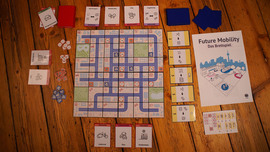
The objective of the game is to be the first to reach 50 points. Points are awarded by completing trips through the city. Trips award more points when they are completed through cleaner or more efficient modes of transportation, or when they are avoided entirely by removing the need to make them. Draw five trip cards from the top of the trip deck and place them face up in front of everyone. Deal each player two power-up cards and select the player who will go first randomly.

In your turn, you first draw a card from the power-up deck. Then you can play any number of power-up cards from your hand. Now, you choose which trip to make by taking one (or more) of the trip cards that are face-up on the table. You then announce your trip to other players, who might choose to play a complication card at this point. You receive points for your trip/s and optional bonus points for using power-ups!

There are power-up cards related to the Avoid, Shift and Improve concepts. With the Avoid cards as work from home, dense city, or delivery you can discard trip cards without making the trips. With the Shift cards, you can permanently improve the city’s infrastructure, and build tram stops, bike or footpaths. Electric vehicles and cargo bikes improve resource efficiency on trips.

Please download the printable files. You will find the game instructions, the game board, the trip and power-up cards, markers, and also a quick reference. The game board consists of 4 parts, each printed on one Din-A4 page. Cut out all the cards and markers and read through the game instructions.

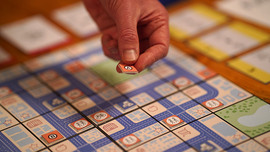
(Notes: The traffic jam markers are placed in the center of any game cell, not on the stars (as shown in the video). The stars are reserved for tram stops, bicycle lanes, and footpaths, a maximum of 2 per cell.) 
 
All files and source files are available at the GitHub repository.

Criterias

Guidance needed?: 
no

Télécharger

Licence:

Files: 
Credits Collection: 
Designed and developed by Eric Londaits for IMAGINARY gGmbH. Translation to German by Elisabeth Schaber, and Andreas Matt. Playtesting by Andreas Matt, Bianca Violet, and Johanna Marschall.
Avec le soutien de: 
Developed by IMAGINARY for Futurium.
Image Collection: 

Exhibition/User:

School Taskbook: From 5 to 15

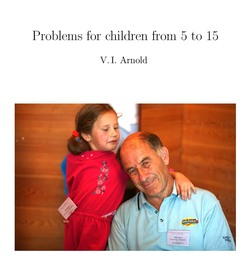
The taskbook for school students by renowned Russian mathematician Prof. Vladimir Igorevich Arnold. You can find the original Russian version as well as an English, German, Spanish, Italian, Vietnamese and Turkish translation.

If you are interested to add a new translation, please see the github repository of the booklet for all sources and details.

Image: 
Contributor(s): 
Vladimir Igorevich Arnold
Victor Goryunov
Sabir Gusein-Zade
File(s) with Language: 
File title: 
Problems for Children from 5 to 15 (English)

File language:

File title: 
Problems for Children from 5 to 15 (Russian)

File language:

File title: 
Problems for Children from 5 to 15 (German)

File language:

File title: 
Problems for Children from 5 to 15 (Spanish)

File language:

File title: 
Problems for Children from 5 to 15 (Vietnamese)

File language:

File title: 
Problems for Children from 5 to 15 (Italian)

File language:

File title: 
Problems for Children from 5 to 15 (Turkish)

File language:

File title: 
Problems for Children from 5 to 15 (Dutch)

File language:

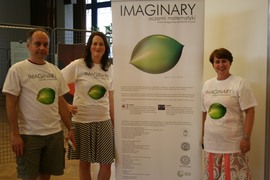
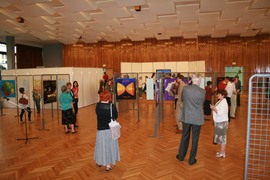
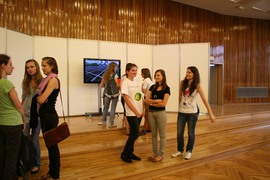
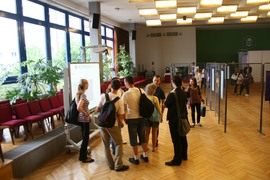
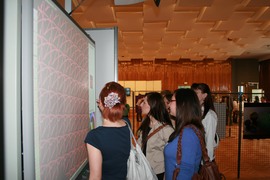
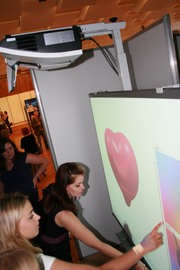
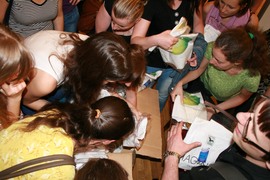
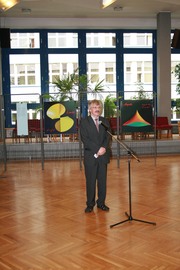
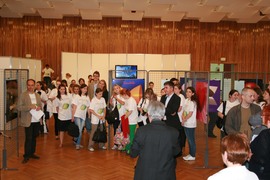
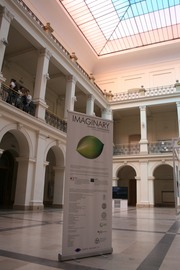
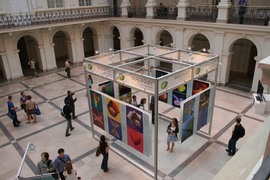
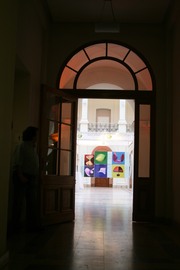
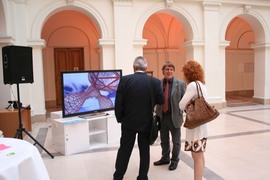
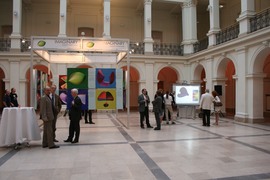
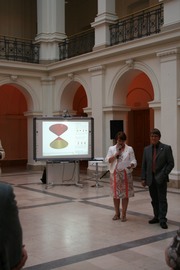
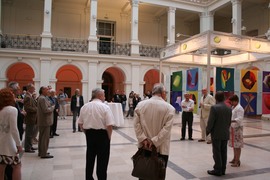
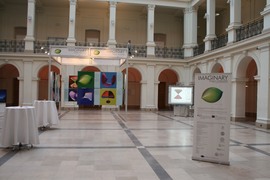
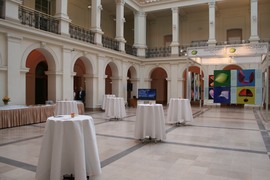
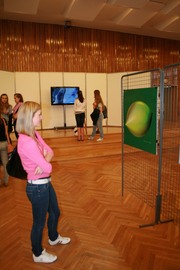
IMAGINARY in Warsaw

Time and Place: 
Dimanche, Mai 29, 2011 - 22:00 au Samedi, Juin 11, 2011 - 21:45
Venue: 
Aula, Faculty of Physics
Warsaw University of Technology
ul Kaszykowa 75
00-662 Warsaw
Poland
Coordinates: 
POINT (21.0080074 52.2223616)
Opening Hours: 

Monday to Friday: 10 am – 5 pm

Files: 
Poster of the exhibition in Warsaw (pdf)
Image Collection: 
Credits: 
Warsaw University of Technology
Avec le soutien de: 
German Embassy in Warsaw, Goethe Institute

Katzengold: Pyrite, Plato, and a Polynomial

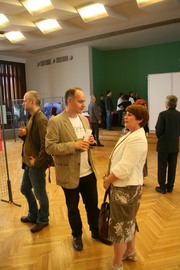
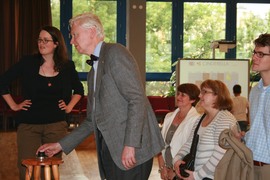
What are the similarities of the mineral pyrite, the dodecahedron as the fifth Platonic solid, and a polynomial of degree 16? This paper explores this connection by using the free software SURFER of the IMAGINARY open mathematics platform, which leads to fascinating pictures displaying transformations from a cube to a dodecahedron, to a rhombic dodecahedron, and to an octahedron, using a single formula. A survey on the ideas and the mathematics behind these visualizations is given. In fact, everyone can explore and modify these forms in real time using the SURFER software. Moreover, the authors have created a short movie, demonstrating the simple geometric beauty.

Image: 
Contributor(s): 
Stephan Klaus and Bianca Violet
Sophia Jahns
File(s) with Language: 
File title: 
Katzengold: Pyrite, Plato, and a Polynomial

File language:
File title: 
Katzengold: Pyrit, Platon und ein Polynom

File language:
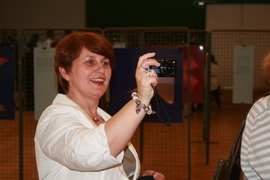
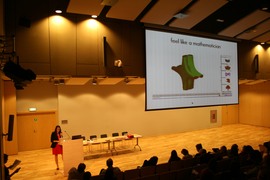
IMAGINARY in Krakow

Time and Place: 
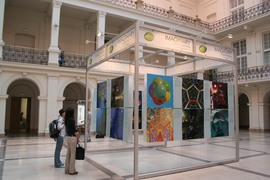
Mercredi, Juin 1, 2011 - 22:00 au Samedi, Juin 18, 2011 - 21:45
Venue: 
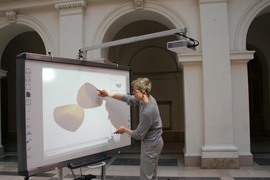
Faculty of Mathematics
Pedagogical University of Krakow
ul Podchorazych 2
30-084 Krakow
Poland
Coordinates: 
POINT (19.9087301 50.0745327)
Opening Hours: 

Monday to Friday: 10 am – 5 pm

Files: 
Poster of the exhibition in Krakow
Image Collection: 
Credits: 
Pedagogical University of Krakow
Avec le soutien de: 
German Embassy in Warsaw and the Goethe Institute.

Open Lab Evening at Futurium: Future Mobility – the board game

This is the board game version of the Future Mobility Simulator, an exhibit at the Futurium, where players can design a city with Lego bricks and explore various future mobility scenarios. 

Apart from playing the game, the workshop will explore the scientific principles and urban planning concepts behind it, such as the “Avoid—Shift—Improve” model, encouraging players to think critically about mobility solutions.

Time and Place: 
Jeudi, Septembre 19, 2024 - 00:00 au 23:45
Venue: 
Futurium
Alexanderufer 2
10117 Berlin
Germany
Coordinates: 
POINT (13.3743507 52.5240876)
Opening Hours: 

17:00 – 20:00

Files: 
Image Collection: 
Credits: 

Pages