Rechercher

Onglets principaux

Résultats de la recherche

Nombre total de résultats : 127.

Mathematikon - Grand Opening of the Shopping Center

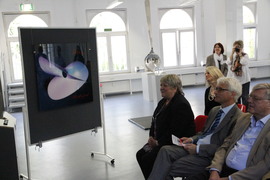
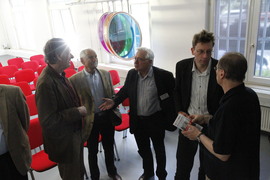
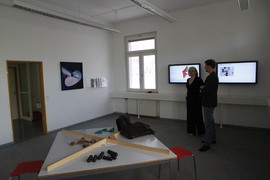
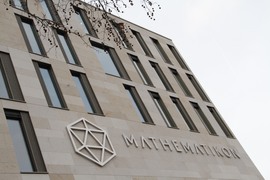
Today, the first mathematical shopping center opens in Heidelberg, Germany. The Mathematikon shops are integrated into the building complex called Mathematikon.

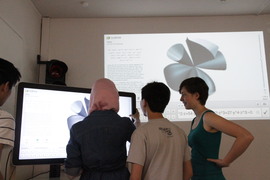
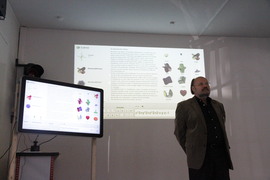
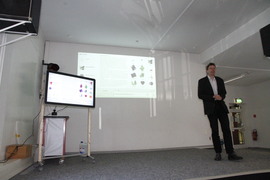
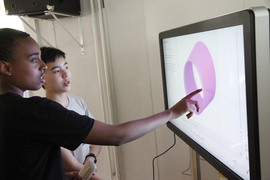
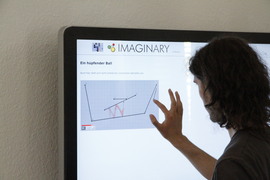
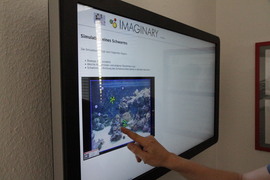
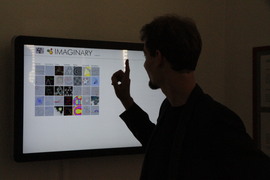
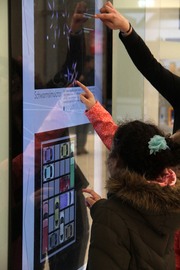
Together with mathematicians from 14 countries, IMAGINARY created the mathematical content and is also responsible for the exhibition design. A highlight is the 84 inch touch screen, which is mounted vertically and offers two different math games at the same time in different heights. It is suitable for all ages and the perfect family attraction. The apps and games are based on the Cinderella applets, known from many IMAGINARY exhibitions.

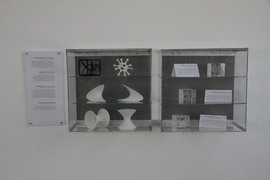
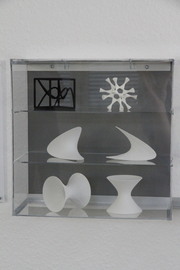
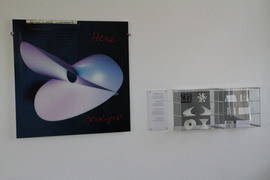
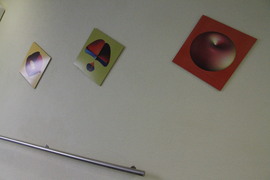
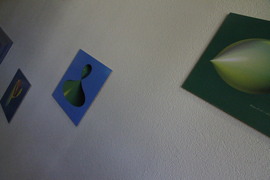
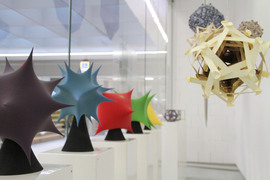
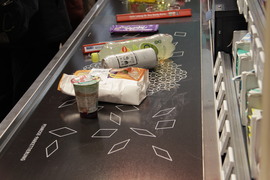
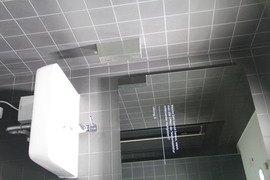
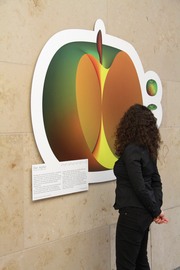
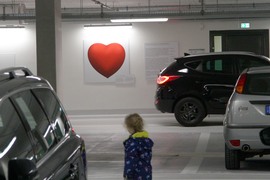
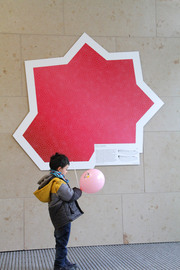
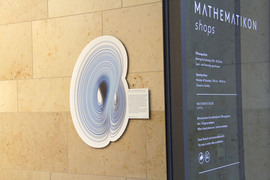
A mathematical image gallery with 13 big format prints and explanations is displayed in the general public area and the parking garage, providing unusual insights into different fields of mathematics. The conveyor belts at the cashiers in the super market invite you to playfully think about classic and modern mathematics. You can experiment yourself using the items you want to buy – juice packages, bottles, oranges, eggs… anything. There is even math in the bathroom: riddles are projected within the mirrors. Additionally, a 13 meter shop window presents a group of exhibits showing all kinds of polyhedra, starting with the platonic solids. Detailed descriptions explain the corresponding mathematical ideas and encourage you to look closer and think further.
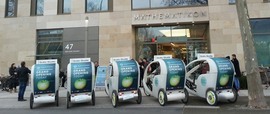

Image Collection: 
Files: 

IMAGINARY à l'EXPERIMINTA de Francfort

Avec ce nom, «IMAGINARY» fait allusion à la notion fictive, inconcevable des mathématiques. Des formules mathématiques abstraites naissent. 

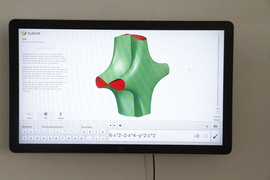
La première exposition est le programme interactif SURFER, qui permet aux visiteurs d’entrer des formules sur des écrans tactiles géants d’un doigt ou d’un mouvement rapide, de les modifier en usant de sa créativité, de définir les couleurs des surfaces émanentes ou de les retourner. Ainsi des images de surfaces algébriques sont générées d’une manière simple et évidente. 

Un autre écran tactile présente le programme interactif sur la géométrie Cendrillon. Les visiteurs peuvent créer aisément et rapidement des constructions géométriques incluant des fractales. Par ailleurs, certains peuvent effectuer des simulations physiques avec des masses, des ressorts et des domaines. Cela permet aussi de retravailler et de compléter les objets exposés consacrés à d’autres thèmes. Libre des limitations de la réalité, on peut simuler des scénarios venant de divers domaines tels la méchanique, la physique des atomes et le mouvement des planètes. 

En ce qui concerne le développement des logiciels: le projet IMAGINARY a été élaboré par l’Institut de Recherche en Mathématiques d’Oberwolfach tel une exposition alliant esthétisme et voyage interactif. L’exposition est couronnée de succès en Europe mais aussi aux Etats-Unis et en Russie. Elle est soutenue par la Fondation Klaus Tschira à Francfort, entre autre. En plus de l’Institut de Recherche en Mathématiques d’Oberwolfach et le Muséum Allemand à Munich , EXPERIMINTA à Francfort est la seule institution allemande exposant les programmes IMAGINARY. Les expositions EXPERIMINTA sont financées par la fondation Citoyenne. 

Time and Place: 
Mercredi, Juin 5, 2013 - 00:00 au 23:45
Venue: 
EXPERIMINTA
Hamburger Allee 22-24
60486 Frankfurt am Main
Germany
Coordinates: 
POINT (8.6479 50.11544)
Opening Hours: 

Monday 9am - 2pm
Tuesday to Friday 9am - 6pm
Saturday/Sunday 10am - 6pm

Files: 
Image Collection: 
Credits: 
EXPERIMINTA

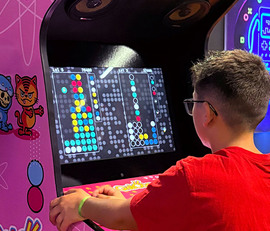
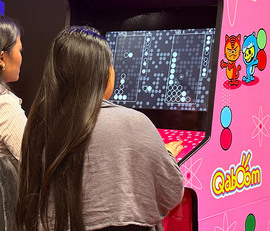
Quantum Arcade

Game 1: Qaboom 

Note: this game is made for a physical Arcade Machines, so it is a different experience to play it at home on your computer (it still works, not tested for tablets or phones). Controls: Player 1 with “wasd” for movement and “e” for flip and “q” for swap. Player 2 with “ijkl” and “o” and “u”. With “r” you can exit the game and with “p” you can pause/unpause the game. We also have gamepad support (still in test phase).


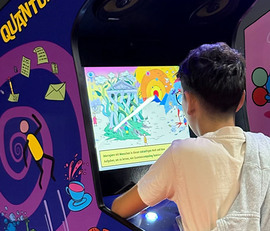
Game 2: Quantum Quest

Note: this is still a prototype and not yet fully ready for home or custom use (it is made for Arcade Machines!). Controls: Player 1 with arrow keys for movement and “e” for exit. Press “l” for language to switch between German and English.

Motivation

Quantum computing has gained global attention over the past two decades and is considered a transformative future technology. To familiarize the general public, particularly young people, with the foundational mathematical concepts and ideas behind quantum computing— and to encourage their participation — a low-threshold, audience-oriented approach is essential.

Goals and Approach

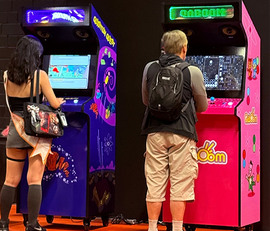
Our goal is to communicate the mathematical core concepts of quantum computing through games. We are developing two computer games: a skill-based platformer and a puzzle game. These will be presented as arcade machines in museums, public spaces, and events such as major video game conventions. The games will be accompanied by workshops featuring coding and co-creation components. Additionally, the project includes an openly published evaluation of knowledge transfer right from the beginning.

Innovation and Perspectives

The project’s innovation lies in transferring knowledge through arcade machines featuring computer games and showcasing these machines in museums and at a gaming convention. The computer games and workshop curriculum are openly licensed, allowing for further development and reuse of the content, including in participatory workshops, by museums and other multipliers. The project will be evaluated with input from the target audience from the outset. All content will be shared at international conferences and through partner networks.


This project is part of the program “Quantum aktiv – Outreach-Konzepte und Open Innovation für Quantentechnologien” by the BMBF. The project partners are IMAGINARY and the Max- Planck-Institut für Mathematik in den Naturwissenschaften. The Arcade Machines will be presented in Arcade Machines and will tour Germany. Supported by the Federal Ministry of Research, Technology and Space (Bundesministerium für Forschung, Technologie und Raumfahrt), Germany


Team: 
Andreas Matt (IMAGINARY)
Erika Roldan, Jörh Lehnert (MPI_MiS)
Eva Specker (IWM)
Nat Alison
Eric Londaits
Christian Stussak
Skye Rothstein
Karla Schön
Oliver Schön
Elisabeth Schaber
Alexa Lehmann
Ariel Kahtan
Retromat
Avec le soutien de: 
Federal Ministry of Research, Technology and Space (BMFTR)
Image Collection: 
Files: 
Quantum Arcade Postcard
Qaboom Manual (interim first version)
Timeframe: 
Jeudi, Février 1, 2024 au Mercredi, Décembre 31, 2025
Open/Closed: 
Open

Math Family Day

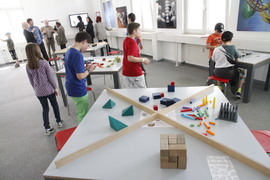
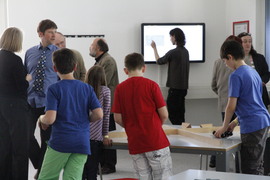
Various stations encourage everyone to get in touch with their mathematical site. Playful construction, soap bubbles, and savvy card games can be experienced together. A small list of all activities:
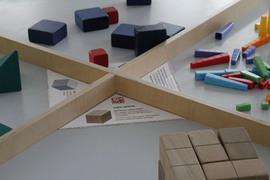
  • Geometry with Pattern Blocks and Zometool
  • Science Toys by Grunda Wichmann
  • Sudoku, Brainteaser and more riddles
  • interactive SURFER station to create algebraic surfaces (take home a print out of your surface/s!)
  • mathematical soap bubbles
  • the impossible triangle

Date and Time:

What:     Open day of Mathematics for the whole family

When:    Saturday, 6th September, 14 – 18 Uhr

Where:   Schulgarten Moabit, Birkenstraße 35, 10551 Berlin

Schulgarten Moabit, Birkenstraße 35, 10551 Berlin
  • Beim Mathe-Familien-Tag bieten wir ein abwechslungsreiches Programm mit mathematischen Themen, das alle Familienmitglieder – Kinder, Eltern, Großeltern – anspricht und zum gemeinsamen Erleben und Entdecken anregt. Es wird eine bunte Mischung aus offenen Angeboten und betreuten Stationen geben, sodass jeder eine für sich passende mathematische Aktivität finden kann.

Hier ist für jeden etwas dabei, für große und kleine Tüftler, für Rechengenies und solche, die es werden wollen.

Mathematik für die ganze Familie – das wird der Mathe-Familien-Tag am 6. September in Berlin! An vielen unterschiedlichen Stationen kann man einen Nachmittag lang spielen, bauen, basteln, konstruieren und programmieren. Und das alles kostenlos im Schulgarten Moabit!
Time and Place: 
Vendredi, Septembre 5, 2014 - 00:00 au 23:45
Venue: 
Schulgarten Moabit
Birkenstraße 35
10551 Berlin
Germany
Coordinates: 
POINT (13.33961 52.53306)
Opening Hours: 

14:00 - 18:00

Files: 
Press Release (German)
Image Collection: 
Credits: 

Mathematikon in Heidelberg

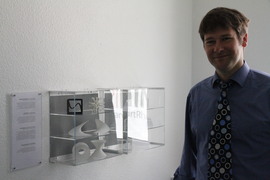
The mathematical image gallery: Twelve large format images are presented together with easy-to-read descriptions. They provide an insight into different fields of mathematics.

The conveyor belts: For the supermarket and the drug-store of the shopping center, we created four different mathematical designs for the conveyor belts, so waiting at the cashiers can be fun and entertaining.

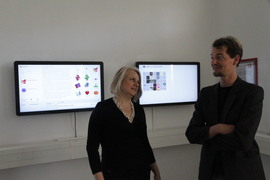
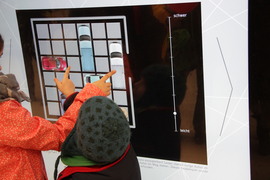
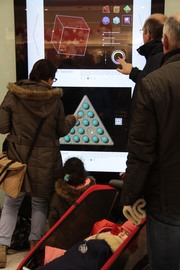
The multi touch screen station: The highlight of the mathematical content in terms of popularity as well as state of the art technology is the 84 inch multi touch screen station. It is mounted vertically in the central hall of the shopping mall. Altogether 10 interactive math games based on the Cinderella applets by Jürgen Richter-Gebert are offered, two of them can be explored at the same time; at a height for adults and children.

Riddles: Integrated in the bathroom mirrors are screens, which display 25 short riddles. The technique hides the screens, so only the writing can be seen. After a countdown, the solution is given, which is mostly just one word or a number. The riddles are of varying difficulty and cover different areas of mathematics.
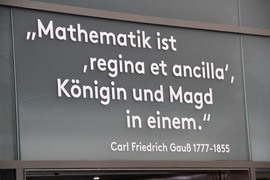
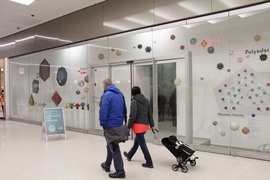
Classic quotes: Two classic mathematical quotes by Gauss and Galileo are displayed on the glass walls near the elevators to be viewed from almost any angle in the public area of the shopping center. The quotes intend to be thought provoking and emphasize the central and important role of mathematics.
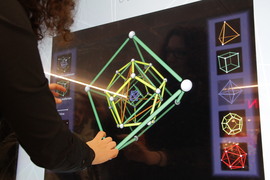
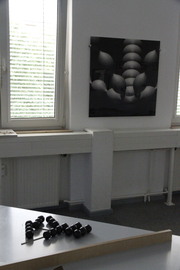
Shop window display: Shop windows of an unoccupied shop unit were used to temporarily display a combination of math and art. Starting with the general concept of polyhedra, we introduce some basic background information like the Euler characteristic, nets of polyhedra and more.

Time and Place: 
Jeudi, Février 18, 2016 - 00:00 au 23:45
Venue: 
Mathematikon shops
Mathematikon
Berliner Str. 41-49
69120 Heidelberg
Germany
Coordinates: 
POINT (8.675543 49.4187591)
Files: 
press release of the opening (German)
Bridges paper on the Mathematikon (English)
Image Collection: 
Credits: 
The Mathematikon building complex has been planned and built by the Mathematikon Heidelberg GmbH (n. S. R.) & Co. KG.

LPDJLQH D VHFUHW

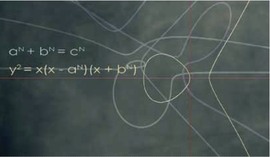
Les triplets pythagoriciens comme (3, 4, 5) ou (4961, 6480, 8161) étaient bien connus des Babyloniens autour de 1600 av. J-C. Ils connaissaient également leur correspondance avec les triangles rectangles à cotés entiers et le problème consistant à scinder un carré donné en deux carrés. Bien que de tels triplets aient été étudiés en détail depuis le temps d’Euclide, autour de 300 av. J-C, ce fut seulement au milieu du XVIIème siècle que Pierre de Fermat formula l’observation suivante : « il est impossible de partager soit un cube en deux cubes, soit un bicarré en deux bicarrés, soit en général une puissance quelconque supérieure au carré en deux puissances de même degré »

Ceci devint le fameux « dernier théorème de Fermat » établissant que l’équation a^n+b^n=c^n n’a pas de solution entière non nulle dès lors que n est plus grand que deux. Il a été prouvé entièrement en 1994, à peu près trois siècles et demi plus tard, utilisant la théorie des courbes elliptiques… développée au XXème siècle !

Les courbes elliptiques ont de belles et profondes propriétés. Ce sont des courbes planes du type y²=x³+a·x+b et qui ont été étudiées depuis le XIXème siècle. Cette équation dans le plan affine correspond à l’équation homogène y²z= x³ + a·xz² + b·z³ qui décrit dans l’espace une famille de surfaces algébriques à deux paramètres a et b. La variation computationnelle de ces équations génère de belles animations qui stimulent notre imagination et évoquent notre créativité mathématique.

La cryptographie est un ensemble de méthodes sûres permettant de transmettre et protéger informations précieuses et secrètes. Depuis 1977, le système de chiffrement asymétrique RSA est largement utilisé. Il est basé sur la théorie des nombres premiers et sur la difficulté de factoriser les grands nombres entiers. Suite à l’impact de la méthode des courbes elliptiques pour la factorisation d’entiers, les mathématiciens ont inventé en 1985 la cryptographie sur les courbes elliptiques (ECC, pour « Elliptic Curve Cryptography » en anglais) et, depuis, la sophistication mathématique de la cryptographie a été portée à un tout autre niveau.

La sécurité des algorithmes ECC est basée sur le problème logarithmique des courbes elliptiques qui semble être un des plus grands problèmes de l’arithmétique des corps finis. Les avancées récentes laissent entendre qu’un certain niveau de sécurité désiré peut être obtenu avec des clefs significativement plus petites, par exemple, qu’une clef ECC de 160 bits fournit le même niveau de sécurité qu’une clef RSA de 1024 bits.

La théorie des courbes elliptiques illustre la beauté des liens entre la théorie des nombres, l’algèbre et la géométrie et fournit un puissant outil mathématique pour renforcer la sécurité du commerce électronique et des communications. La vielle et peu fiable méthode de chiffrement par décalage, utilisant la trop simple opération mathématique consistant à chiffrer un message dans l’alphabet usuel au moyen de la formule d = c - 3 (mod 26) est obsolète. Cependant, elle nous donne la clef pour déchiffrer le titre de ce film :

_ _ _ _ _ _ _ _ _ _ _ _ _ _

Pour télécharger le film en haute résolution en portugais, allemand, anglais et espagnol, visitez : http://www. cim.pt/LPD-UHW

Embed External Video: 
Credits Collection: 
Initiative by Centro Internacional de Matemática, Casa da Animação and Mathematisches Forschungsinstitut Oberwolfach.
José Francisco Rodrigues
Victor Fernandes, Stephan Klaus, Armindo Moreira, José Francisco Rodrigues
Victor Fernandes, Armindo Moreira
Andreas Matt, Bianca Violet
Victor Fernandes, Armindo Moreira
Avec le soutien de: 
Acknowledgments: CMAF/Universidade de Lisboa, Fundação Calouste Gulbenkian, IMAGINARY exhibition, Vila de Óbidos Sponsored by CIÊNCIA VIVA.
Files: 
Image Collection: 

Exhibition/User:

Pages