Rechercher

Onglets principaux

Résultats de la recherche

Nombre total de résultats : 127.

Keplers First Two Laws

Description

Description: 

The first two laws of Kepler’s Planetary Motion   


Johannes Kepler was a German Astrophysicist who developed three important laws of planetary motion. His announced his first two laws in 1609 and the third nearly a decade in 1618. This exhibit demonstrates the first two laws of Kepler’s planetary motion


The First Law

The first law states that celestial bodies move in an ellipse with the central body at one of the foci of the ellipse. This means that the distance from the central body to the celestial body varies as the planet moves through its orbit. The eccentricity of the orbit is a number which describes how eccentric an ellipse is. An eccentricity of 0 is a perfect circle, an eccentricity between 0 and 1 is an ellipse, and eccentricity of 1 or greater is an escape orbit. Exhibit B is an interactive display, which shows the relationship between the distance between the two foci and the eccentricity of the orbit


The Second Law

The second law states that when a line segment joining the celestial body and the central body sweeps out equal areas during equal periods of time. This is shown with the two triangles in Exhibit A. This law shows that when the celestial body is faster when it closer to the central body and slower when further away. In terms of the model, when the celestial body is in position one, it is going faster than when in position two.

Die Ersten zwei Keplerschen Gesetze


Johannes Kepler war ein Deutscher Astrophysiker , der drei wichtige Gesetze zur bewegungsweise von Planeten entwickelte.Er veroeffentlichte sein erstes Gesetz 1609 und das dritte beinahe ein Jahrzehnt später im Jahr 1618. Dieses Ausstellungsstück veranschaulicht die ersten zwei  Keplerschen Gesetze.


Das erste Gesetz

Das erste Gesetz besagt, dass Trabanten sich in Ellipsen bewegen und der Zentralkörper in einem der beiden Brennpunkte liegt. Das bedeutet , dass die Entfernung zwischen Zentralkörper und Trabant variiert während der Trabant sich um den Zentralkörper bewegt.

Die Exzentrizität der Umlaufbahn ist eine Zahl, die beschreibt, wie exzentrisch eine Ellipse ist. Eine Exzentrizität von 0 ist ein perfekter Kreis, eine Exzentrizität zwischen 0 und 1 ist eine Ellipse und eine Exzentrizität von 1 oder größer ist eine Fluchtbahn.

Ausstellungsstück B, ist ein interaktives Ausstellungsstück, welches die Beziehung den beiden Brennpunkte zur äußeren Linie zeigt.


Das zweite Gesetz

Das zweite Gesetz besagt, dass der Fahrstrahl, eine Linie die den Trabant und den Zentralkörper verbindet, in gleichen Zeiten, gleiche Flächen überschreitet. Im Modell wird das durch die zwei gleichgrossen Dreiecke gezeigt. Dieses Gesetz zeigt auch ,dass der Trabant schneller ist,wenn er näher am Zentralkörper ist was heißt, dass der Planet an Position eins schneller als an Position zwei ist.

Criterias

Guidance needed?: 
no

Télécharger

Files: 
Credits Collection: 
Image Collection: 

Exhibition/User:

Data Sonification

Description

Description: 

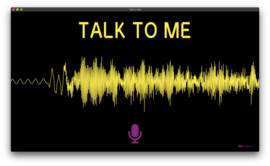
We are using 3 tracks (see credits below) that use sonification of climate change data. 

The Deafening Rise of Carbon Pollution (1:32)

The pitch of each note represents the monthly concentration of CO2 from 1958 to 2017. The higher the pitch, the higher the concentration.


Sonification Of Arctic Sea Ice  (1:29)

An index of total ice cover in the Arctic Ocean from 1979 to 2016. Each note represents one month of data. The lower the pitch, the smaller the ice sheet. You hear the growth each winter and the melt each summer.


The Sound of Earth’s Fever (1:03)

A sonic interpretation of the global mean surface temperature index, higher notes mean higher temperatures. In 1977 there is a pause to draw attention to the warming that has occurred since then.


All files are provided in their original version and remastered versions for use in the 10-Minute Museum. We created a final mixdown for the exhibition with all tracks and voiceovers (in German), available here.


—- Full Credits —-

All songs by Judy Wedt.

Track 1 features overlaid natural sound recordings of waves, ships, and bowhead whales recorded by Kate Stafford.

Tracks 2 and 3 were co-created with Dargan Frierson.

Voice-over for the mixdown with all tracks by Laura Fregonese.


— Notes —

The tracks are binaural audio, and they don’t sound the same when played with a straight downsample to mono (e. g. using a single speaker) because of interplay between channels. The mono mixes provided lose some sound (which is inevitable), but try to salvage the situation through different strategies:

  • The Deafening Rise of Carbon Pollution: An asymmetrical mix was used.
  • Sonification of Arctic Sea Ice: One of the channels was inverted for our mix. Otherwise, a piano sound disappeared


Crédits

Credit Text: 
All songs by Judy Wedt (http://www.judytwedt.com). -- Track 1 features overlaid natural sound recordings of waves, ships, and bowhead whales recorded by Kate Stafford. Tracks 2 and 3 were co-created with Dargan Frierson. -- Voice-over by Laura Fregonese.
Contributor(s): 
Files: 
Image Collection: 
Applet height: 
800px

Exhibition/User:

Licenses: 

Part:

License:

Forum de la communication scientifique 2014

Le projet «arrêt sur image sur les mathématiques modernes» présente un texte court (approximativement 5 à 8 pages en format A5) expliquant un problème ou une idée mathématique en rapport avec un des programmes scientifiques de l’IRM. Cette action vise un public large composé d’élèves de lycée, de professeurs de mathématiques, de journalistes scientifiques et d’autres personnes intéressée par le domaine des mathématiques modernes. Ces textes peuvent être écrits tant en anglais qu’en allemand. 


La présentation inclue une description générale du projet. Un débat prendra en compte les questions:

  • Comment est-ce qu’un institut international de recherche peut communiquer sur ses résultats récents de manière optimale?
  • Est-ce que les scientifiques écrivent des textes clairs sur leurs recherches?
  • Comment peuvent-ils être guidés ou soutenus dans leurs démarches textuelles? 
  • Comment est-ce que des textes concernant des recherches récentes peuvent intéresser un large public?

Le projet arrêt sur image fait partie de l’action «Oberwolfach à la rencontre d’IMAGINARY» pour lequel l’IRM a reçu une importante bourse de la fondation Klaus Tschira et la fondation Oberwolfach. Dans ce projet, il est prévu de créer et de collecter des textes de qualité sur la communication des mathématiques sur la plateforme www. imaginary.org. Notre but est de promouvoir la compréhension et l’appréciation tant des mathématiques modernes que des recherches sur les mathématiques pour le grand public et de fournir aux personnes intéressés (exposants, professeurs et journalistes scientifiques) des aperçus sur les mathématiques modernes. 

En plus de la présentation des arrêts sur image et d’une affiche, IMAGINARY est présent au forum du festival de films Fast Forward Science. Le membre d’IMAGINARY Guillaume Jolvet y reçevra le premier prix de la catégorie «Substance» avec son dernier film »Glacial Mistery». Il a été soutenu entre autres par les membres d’IMAGINARY Antonia Mey et Bianca Violet pour la production du film.

Time and Place: 
Dimanche, Décembre 7, 2014 - 00:00 au Mardi, Décembre 9, 2014 - 23:45
Venue: 
Kongresshotel Potsdam
am Templiner See
Am Luftschiffhafen 1
14471 Potsdam
Germany
Coordinates: 
POINT (13.012962 52.374748)
Files: 
IMAGINARY poster (DE) (pdf)
Image Collection: 
Credits: 

Two AI workshops as a part of the Athens Science Festivals

The Athens Science Festival, the festival devoted to Science and Innovation since 2014, is an established cultural landmark in the field of Science, Technology, Innovation, and Art in Greece!

We will ask a neural network to recognize our handwritten numbers and line drawings during the workshops and find out how it is trained. On a treasure hunt, we will investigate different strategies to get to the treasure before everybody else. We will also use our keyboards to create music with the help of AI and plenty of other cool stuff. With the help of these examples, we will understand key concepts of AI and the mathematics involved.

These introductory courses will be held in German and English.

Introduction to Artificial Intelligence (A2, 13 - 17 years)

Introduction to Artificial Intelligence (A2+, 17 and older)

Time and Place: 
Samedi, Mars 27, 2021 - 00:00 au 23:45
Venue: 
Technopolis
Athens 118 54, Greece
Athens
Greece
Coordinates: 
POINT (23.7103087 37.9767521)
Opening Hours: 

10 - 11.30 CET

Files: 
Image Collection: 
Credits: 

IMAGINARY in Yaroslavl


Time and Place: 
Jeudi, Novembre 22, 2012 - 00:00 au Samedi, Décembre 8, 2012 - 23:45
Venue: 
Demidow University
Jaroslawl
Russia
Coordinates: 
POINT (39.8844708 57.6260744)
Files: 
Image Collection: 
Embed External Video: 
Credits: 
German Embassy in Moscow
Demidov University Jaroslawl

IMAGINARY in Muscat, Oman

Time and Place: 
Dimanche, Novembre 22, 2015 - 00:00 au Jeudi, Novembre 26, 2015 - 23:45
Venue: 
Exhibtion Hall, Sultan Qaboos University, Muscat, Sultanate of Oman
123 Muscat
Oman
Coordinates: 
POINT (58.5517028 23.60917)
Opening Hours: 

10:00 - 17:00

Files: 
Image Collection: 
Credits: 
Thanks to all sponsors and partners which enable the first IMAGINARY exhibition on the Arabian Peninsula.
Prof. Dr. Mehiddin Al-Baali
Prof. Dr. Nasser Al-Salti
Prof. Dr. Bernhard Heim
Max Kleinebrahm
Andrea Koenig
Prof. Dr. Anton Purnama
Prof. Dr. Florian Rupp

Inauguration of IMAGINARY in Tomsk, Russia

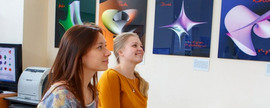
Today the sixth Russian IMAGINARY exhibition opens its doors in Tomsk, Western Siberia. It is coordinate and organized by the German Embassy in Moscow in collaboration with the Polytechnical University of Tomsk. It will be open for the public from the 21st of May until the 3rd of June 2013.

In the event page you will find images and more deails of the exhibition!

Image Collection: 
Files: 

Open Lab Evening at Futurium: Discussion game "Blickwinkel KI"

This workshop, which takes place at FuturiumLab, invites participants to critically examine the ethical and social implications of technological advancements. It reminds us that what is technically possible may not always align with what is socially desirable. Through thought-provoking ideas and experiments, the game sparks discussions about our political and social responsibility in navigating innovation, encouraging us to collaborate in shaping these developments for the future.


  • Admission: free of charge
  • Event language: German
  • Max. Number of participants: 20 people
  • Conditions of participation: no previous knowledge is required
  • Age recommendation: from 10 years (participation of persons under 16 years is only possible if accompanied by a parent or guardian).
Time and Place: 
Jeudi, Octobre 10, 2024 - 00:00 au 23:45
Venue: 
Futurium
Alexanderufer 2
10117 Berlin
Germany
Coordinates: 
POINT (13.3743507 52.5240876)
Opening Hours: 

17-20

Files: 
Image Collection: 
Credits: 
Pages