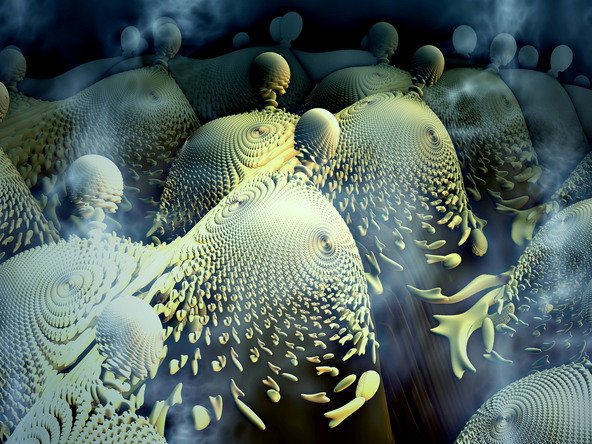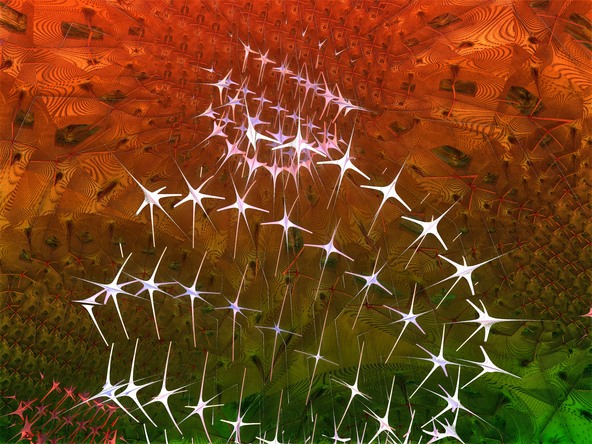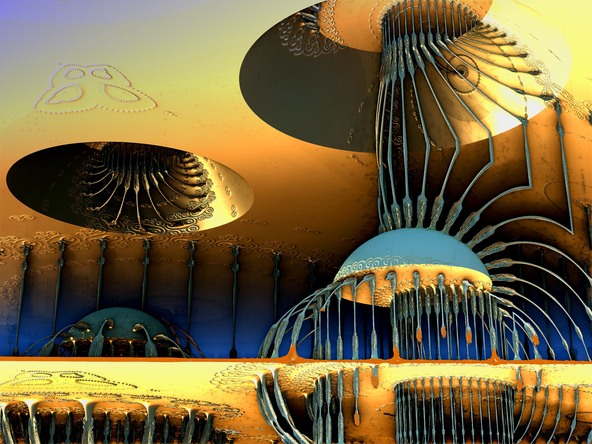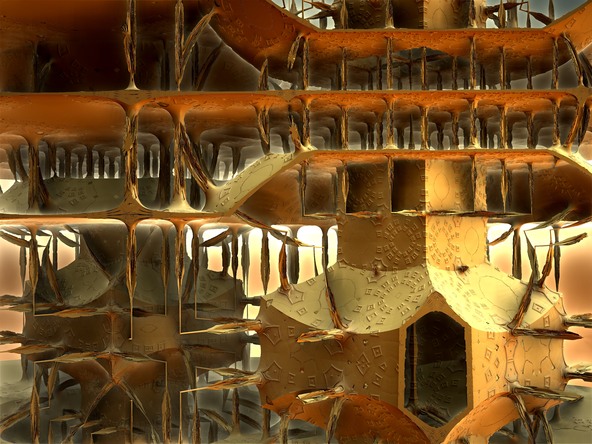
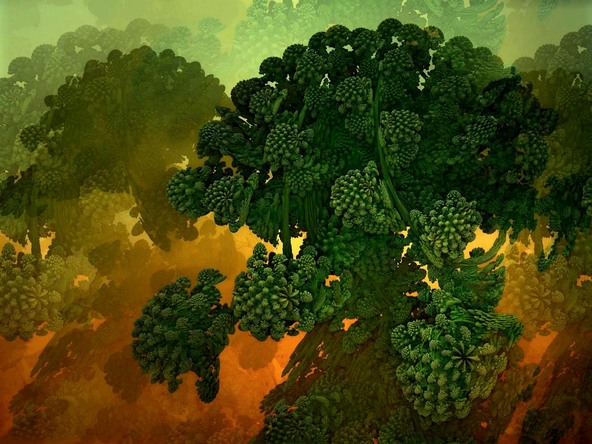
Hiltrud Heinrich - Fractals
Submitted by Hiltrud Heinrich on
Submitted by MPE 2013 on
MPE 오픈소스 전시는 우리 지구의 수학을 테마로 한 세계적 가상 전시로, 박물관이나 전시회에서 사용될 수 있는 다양한 모듈들을 전시합니다. 2013년 5월 유네스코 파리 본부에서 시작한 이래로 계속 성장하고 있습니다.
이 모듈들은 과학 박물관에서 학교까지 세계의 많은 곳에서 재생산되고 활용되고 있습니다. 이 전시는 가상적인 부분뿐만 아니라 실물 부분으로 이루어져 있습니다. 전시의 실물들은 새로 제작되거나 여러 세계 전시에 돌아다니며 사용되고, 프로그램 등의 가상 모듈들은 크리에이티브 커먼스 라이센스에 의해 이용가능합니다.
모든 전시물들은 수학이 지구 환경을 연구하는 데에 어떻게 중요하게 사용되는지 보여줍니다. 모듈들은 천문학, 유체역학, 화산과 빙하 속의 수학, 지도제작 문제 등 다양한 주제들을 다룹니다.
전시의 가상 모듈들은 MPE 2013 계획에 의해 열린 세게 프로그램 공모전의 작품들입니다. 이들은 가상체험 모듈, 영상, 포스터, 물리적 모듈 제작을 위한 설명 이렇게 네 부분으로 준비되어 있습니다. 공모전의 세 우수작품들은 2013년 3월의 우리 지구의 수학의 날(MPE Day)에 유네스코에서 상을 수상하였습니다.
실물 모듈들은 Michel Darche의 지도감독 하에 Centre•Sciences CCSTI of region Centre (Orleans-France) 와 Adecum, Association for mathematic culture development에서 구현해 주었습니다. 이동 전시의 토대가 되는 이 모형들은 대여가 가능합니다.
이 전시는 여전히 개발 중에 있고, 새로운 생각이나 신규 모듈에 대한 아이디어의 제안을 환영합니다. MPE 프로젝트에서 더 많은 정보를 찾아보세요.
우리 지구의 수학 계획에 대한 더 자세한 정보가 알고 싶으시면 www. mathofplanetearth.org을 참고하세요.


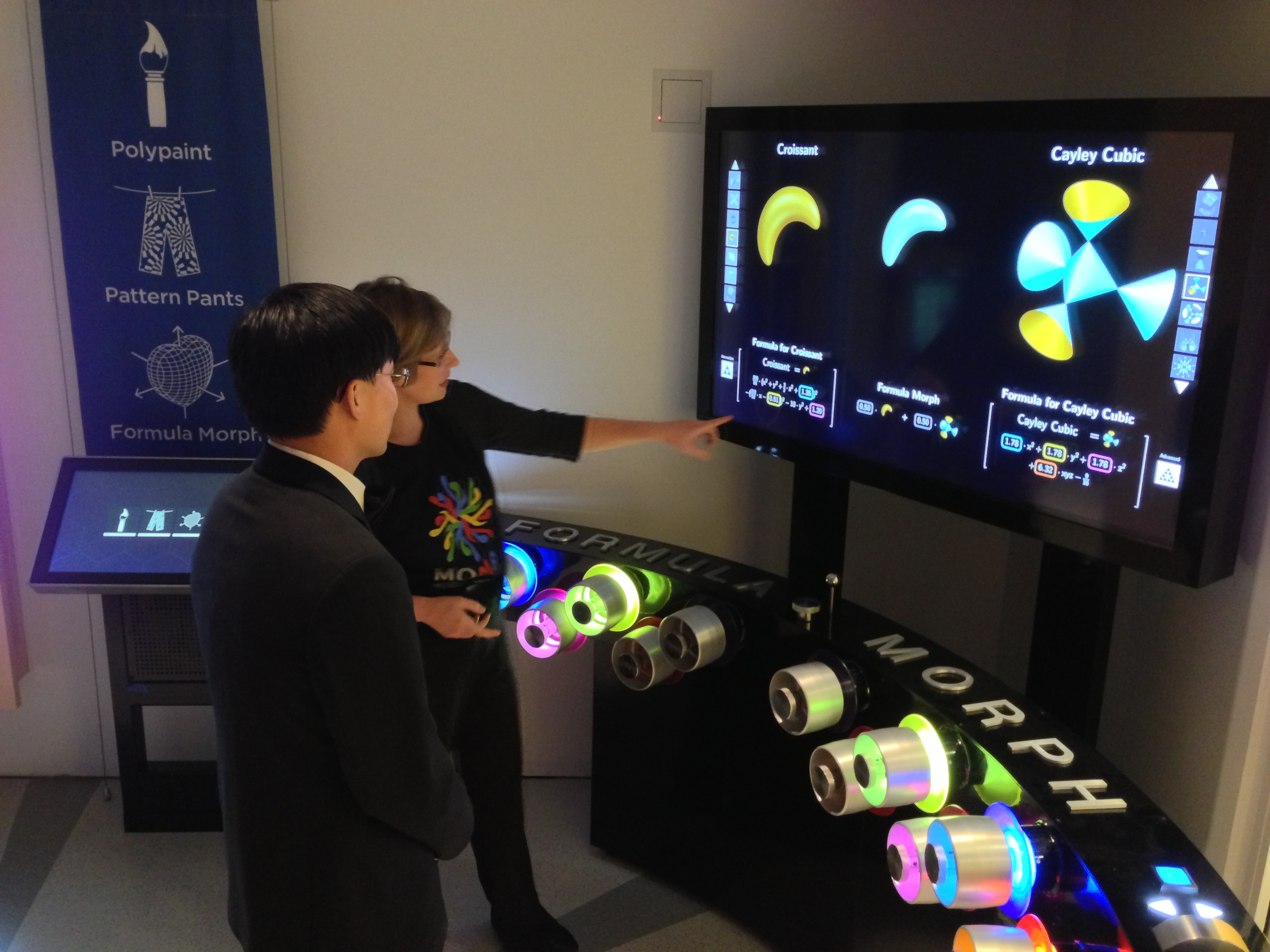
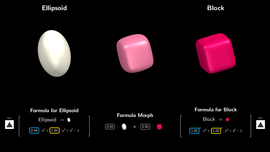
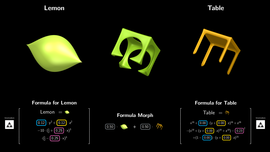
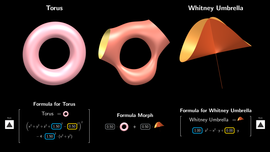
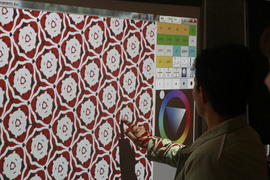
Formula Morph는 프로그램 SURFER의 사용자가 직접 입력하는 방식의 인터페이스입니다. 미국 국립 수학 박물관 (National Museum of Mathematics, MoMath)에 의해 고안되었고 Moey Inc.가 개발한 이 프로그램은, SURFER를 전시회에서 더욱 실질적이고 단순하게 사용할 수 있게 합니다. 현재 MoMath에 전시되어 있습니다.
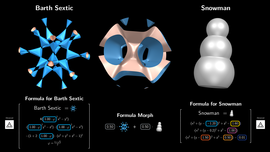
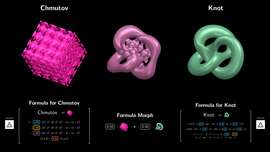
두 개의 대수곡면을 내장된 목록에서 선택하고, 곡면의 매개변수들을 조정해 곡면을 자유롭게 변형합니다. 그러면 두 곡면을 보간(interpolate)해 형성된 제3의 곡면이 중간에 나타나게 되고, 보통 매우 아름답고 놀랄 만한 결과가 나오게 됩니다.
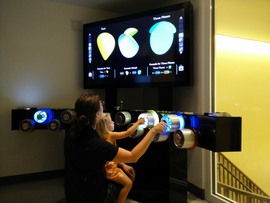
이 가상전시는 휠, 레버, 버튼 등의 물리적 입력장치들로 작동하고, 따라서 박물관 또는 전시회 시연을 위해서는 별도의 물리적 스테이션이 필요합니다. 소프트웨어 패널이 시험 목적으로 제공됩니다. 가정용 및 더 많은 기능을 위해서는, 원래 프로그램 SURFER 사용을 추천합니다.


Submitted by IMAGINARY on
The “Medienpreis Mathematik 2013” by the Deutsche Mathematiker Vereinigung (DMV) goes to Gert-Martin Greuel and Andreas Matt for their work on the project IMAGINARY. The prize is awarded for outstanding contributions to the communication and popularization of mathematics. The award comes with 4000 Euro prize money provided by the Walter de Gruyter Stiftung in Berlin.
The jury consisted of the two mathematicians Günter Ziegler and Michael Joswig and the two journalists Holger Dambeck, SPIEGEL ONLINE, and Christoph Drösser, DIE ZEIT – both of them former DMV Medienpreis winners.
Gert-Martin Greuel and Andreas Matt are awarded for their outstanding activities in the development and implementation of IMAGINARY, a project by the Mathematisches Forschungsinstitut Oberwolfach supported by the Klaus Tschira Stiftung. Jury member Holger Dambeck states that with unique software for everybody to visualize algebraic surfaces, with big media competitions, with worldwide exhibitions and with the internet portal “IMAGINARY – open mathematics”, the project evoke great enthusiasm for mathematics in Germany and abroad.
In addition to the media award, the DMV also gave a journalist award to Sven Preger for a radio feature on the mathematician Leanordo da Pisa (Fibonacci), and three cartoon awards to Oliver Ottitsch, Katharina Greve and Uwe Krumbiegel for their humorous cartoons on mathematics.
The award ceremony will be held on November 15, 2013, in Berlin. Please find the German press release with more information attached.
An important note for the IMAGINARY team: this award is due to the contribution of all team members and partners to the IMAGINARY project. We would like to especially mention Christian Stussak for his ideas, contributions in software development (SURFER, Formula Morph, et al.) and technical support for all exhibitions and programs, Christoph Knoth and Konrad Renner for the development and design of the IMAGINARY platform, Susanne Schimpf and Anna Hartkopf for their work on the platform, the coordination of exhibitions and events and the communication with our users, to Sebastian Uribe for his assistance in media work and organization. Also to the director of the Mathematisches Forschungsinstitut Oberwolfach Gerhard Huisken and all staff members of the Institute for their constant support and work on logistics, editing, communication and finances for IMAGINARY. And to all our IMAGINARY partners: among them especially the RSME in Spain with Sebastian Xambo, Antonio Campillo and their team for organizing more than 15 exhibitions and several museum installations and for being an integral part of the project, the German Embassy in Moscow for organizing 7 exhibitions in Russia, our partners in Argentina, Portugal, Serbia, China, Panama, Colombia, Switzerland, Austria, Norway, France, et al.
Thank you all!
More details on the prize:
Thomas Vogt
Deutsche Mathematiker-Vereinigung
Medienbüro Mathematik an der Freien Universität Berlin
Tel.: 030 / 838-75657
E-Mail: th.vogt@fu-berlin.de
Cartoons
www. toonpool.com
www. dmv. mathematik.de
More information:
www. imaginary.org
www. mathematik.de
www. mathekalender.de
www. twitter.com/dmv_mathematik
www. facebook.com/dmv.mathematik
www. youtube.com/user/DMVMedien

Submitted by Uli Gaenshirt on
세 변의 길이의 비가 3:4:5인 삼각형은 직각삼각형입니다. 왜냐하면 세 수 3^2 + 4^2 = 5^2가 피타고라스 정리의 등식 a^2 + b^2 = c^2을 만족시키기 때문입니다.
배경의 하얀색 물체는 파라오 쿠푸(Khufu)의 피라미드의 왕의 방(King’s Chamber)의 축소 모형입니다. 놀랍게도, 12개의 매듭이 있는 끈으로 만들어진 빨간 3-4-5 삼각형이 내부공간 안에 정확히 들어갈 수 있습니다.
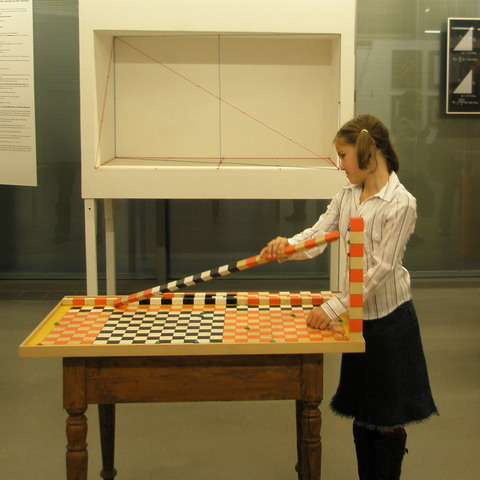
전면의 물체는 피타고라스 정리의 공간 막대 모형(Spatial Pythagorean Stick Model)입니다. 수직 방향의 고정된 막대기에는 3개의 빨강, 초록, 파랑 구슬이 각각 높이 7, 8, 9단위에 박혀 있습니다. 몇 개의 구슬들은 피타고라스 등식의 가능한 정수해를 기준으로 평면에 추가로 박혀 있습니다. 단위길이가 표시되어 제공되는 막대기들은 정수 대각선들의 길이와 일치하게 만들어졌습니다.
공간의 데카르트 좌표계(Cartesian coordinate system), 즉, 직교좌표계에서 점 P0 (0,0,0)과 다른 점 P1 (x,y,z) 사이의 거리 d는 공식 x^2 + y^2 + z^2 = d^2 로 주어집니다.
등식 12^2 + 20^2 + 9^2 = 25^2 에 맞추어, 소녀는 두 파란 구슬을 잇는 정확한 길이의 막대기를 선택했습니다.
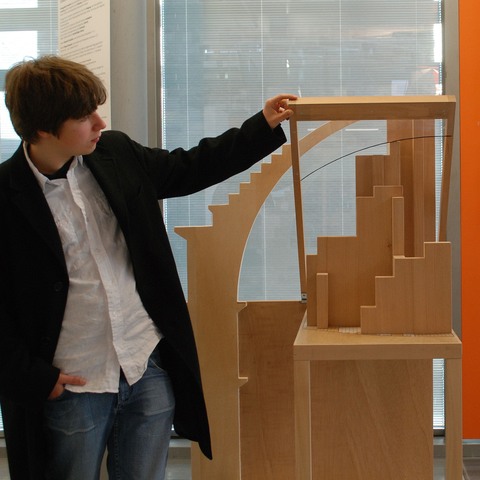
청년이 피타고라스 정리의 구형 모형(Pythagorean Sphere Model)의 활을 움직이고 있습니다. 내부에 검은 선으로 표시된 원의 부분은 반지름 65cm의 구에 접합니다.
이 검은 선이 스치고 지나가는 나무 직육면체들의 꼭지점들은 등식 x^2 + y^2 + z^2 = 65^2의 정수해에 대응됩니다. 실제로 꼭지점 P (15|36|52) 와 만나게 됩니다.
반지름이 65인 구 전체에선 342개의 정수 좌표를 가진 점들을 찾을 수 있습니다.
이 모형에는 120AD 경의 로마의 판테온(Pantheon)이 영향을 주었습니다. 특히 내부공간에 완벽히 들어가는 구의 모습과 89개의 정사각형들이 바닥에 채워져서 16개의 꼭지점에서 만나는 바닥 문양 이 두 가지가 영향을 주었습니다. 이 바닥 문양 디자인은 11 x 3과 7 x 9 크기의 두 개의 직사각형들을 겹쳐 바닥을 깐 것으로, 등식 11^2 + 3^2 = 7^2 + 9^2 에 의해 이 두 직사각형들의 대각선 길이는 같습니다.
피라미드의 4개의 변들은 늘여진 빨간 실들입니다. 까만 삼각형이 피라미드 면의 경사를 알려줍니다. 삼각형의 수평인 변 a와 수직한 변 b의 비는 11:14입니다. a의 값은 보통 220 이집트 로얄 큐빗(Egyptian royal cubits)인 115.19m로 정해지고, 이로 계산한 b는 146.60 m 혹은 280 로얄 큐빗입니다.
이 모형은 황금비 τ (τ = 1.61803…)와 원주율 π (π = 3.14159…)을 이용해 다른 방식으로 높이 bτ 와 bπ 을 구하는 방식을 보여줍니다.
b(τ) = (τ^0.5) a = 146.52 m
b(π) = 4 (π^-1) a = 146.66 m
(주의 사항: τ^0.5 = √τ 그리고: π^-1 = 1/π )
고대의 측량 기술로는 b, bτ, bπ 이 세 값 사이의 차이를 찾을 수 없었습니다. 아마도 피라미드는 근본적으로 기하학적인 건축이라고 생각되었을 것입니다.
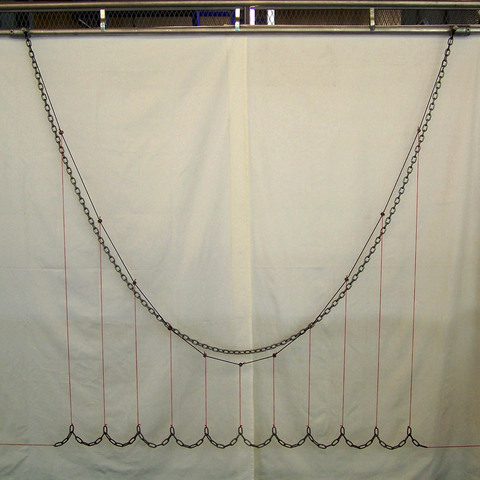
늘어진 사슬의 모양은 현수선(catenary)이라 불립니다. 이 곡선의 대수학적 표현은 y축에 대해 대칭인 두 식 y = 0.5 (e^x) 와 y = 0.5 (e^-x) 의 합으로 이루어집니다. (e = 2.71828…)
만약 우리가 현수교에서처럼 늘어진 선에 등거리의 선으로 이루어진 동일한 하중을 추가한다면, 선의 모양은 보다 뾰족한 포물선(parabola)으로 바뀔 것입니다.
이 변형은 늘어진 선의 가운데에는 다른 곳에 비해서 하중을 주는 더 많은 접점이 붙어 있다는 것을 생각하면 쉽게 이해할 수 있습니다. 가운데 부분에는 더 많은 무게가 실려서 더욱 뾰족한 모양이 되고, 바깥 부분에 적게 실리는 무게는 균일한 무게를 지닌 사슬에 비해 실이 더 늘어진 모양을 하게 합니다.
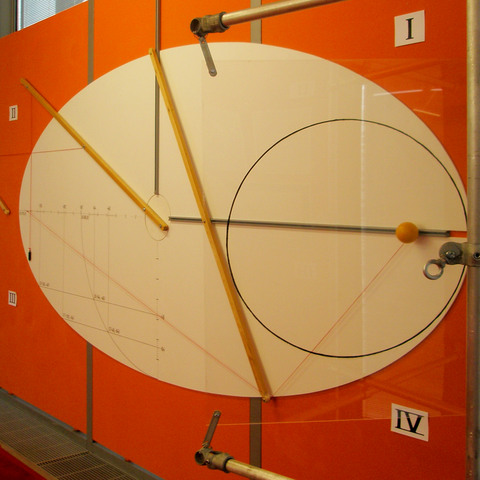
I. 철제 고리로 표시된 관측 구멍에서 보면, 하얀 전체 타원이 아크릴 플렉시글라스에 보이는 검은 원을 정확히 채우게 됩니다. 즉 관측 구멍과 원이 이루는 원뿔의 단면이 타원이 됩니다.
II. 천문학자 요하네스 케플러(Johannes Kepler, 1571-1630)는 두 동심원의 반지름 선분으로 주어지는 교점의 사영으로 타원을 그려냈습니다. 반지름 선분이 내부의 동심원과 만나는 교차점에서 수평선을, 외부의 동심원과 만나는 교차점에서 수직선을 긋습니다. 이 둘의 교차점들을 모두 이으면 타원이 완성됩니다. 좌상단의 교차하는 끈들을 (타원과) 비교해 보세요.
III: 정수좌표 점들의 예를 이용하여 타원이 원을 수평 방향으로 늘인 것을 볼 수 있습니다.
IV. 타원 컴퍼스(ellipsograph)는 미끄러지는 받침대에 놓여 움직일 수 있는 막대기를 이용해서, 두 초점에 끝점이 연결되어 있는 선으로 만들어진 타원을 그려냅니다.
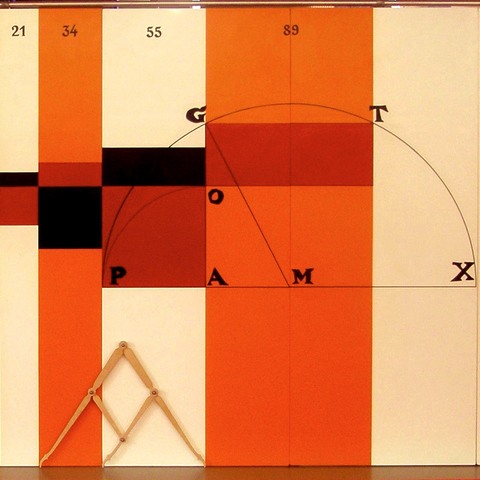
요하네스 케플러(Johannes Kepler)의 디자인인 목판 위에 검은색으로 그려진 도형은, GA = 2 AM 인직각삼각형 GAM의 밑변을 기준으로 어떻게 황금비 OA:GO = GA:OA 를 만들어 내는지 보여줍니다. 정확한 그림에서라면 정사각형 AOP와 직사각형 GOT의 넓이는 동일해야 합니다.
현대에 황금비는 보통 τ = 0.5 (√5 - 1) = 1,6180339887… . 로 정의됩니다. 한편 OA:GO = GA:OA = τ 라는 사실을 참고하세요.
케플러의 목판 위에 나타난 정사각형과 직사각형들의 나열들은 피보나치 수에 의존하고 있습니다. 이는 초기조건 F0 = 0 과 F1 = 1을 갖고 Fn+2 = Fn+1 + Fn 의 점화식으로 정의된 0, 1, 1, 2, 3, 5, 8, 13, 21, 34, 55, 89, … 로 나아가는 수열입니다. 케플러의 공식 Fn+1 · Fn+1 = Fn · Fn+2 +(-1)^n 은 n이 무한대로 갈 때 비율 Fn+1 : Fn 이 τ로 수렴함을 말해줍니다. 예로 n이 9일 때는 큰 빨간색의 사각형 (넓이 3025 cm^2 = 55 cm · 55 cm) 과 큰 빨간색의 직사각형 (3026 cm^2 = 34 cm · 89 cm)의 넓이는 거의 동일합니다.
이 비율에서 나오는 분수들로 황금비에 대한 근사식을 증명할 수 있습니다.
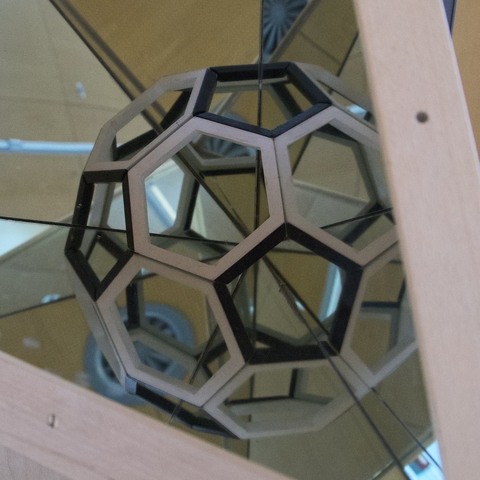
상감 육각형이 20 번 나타나는이 거울 물체는 어린이와 성인에게 매우 인기가 있습니다.
물체는 밑면 대 높이 비율이 1 : 0.5 τ (τ = 0.5 (√5 + 1) = 1.61803 …) 인 이등변 삼각형 형태의 세 개의 거울로 구성됩니다. 이 거울 물체는 나무로 만들어져 있습니다.
거울의 똑같이 긴 측면은 서로 연결되어 있으며 각각 72°의 내부 각도를 형성합니다. 결과적으로 육각형에 부착 된 검은 색 줄무늬가 오각형으로 나타납니다. 여러 예금자가 제공됩니다.
이 갤러리의 일부 개체는 2016 년 6 월 뉘른베르크에서 처음으로 전시 된 “IMAGINARY - Form und Formel mathematischer Fantasie”전시회에 자세히 설명되어 있습니다.
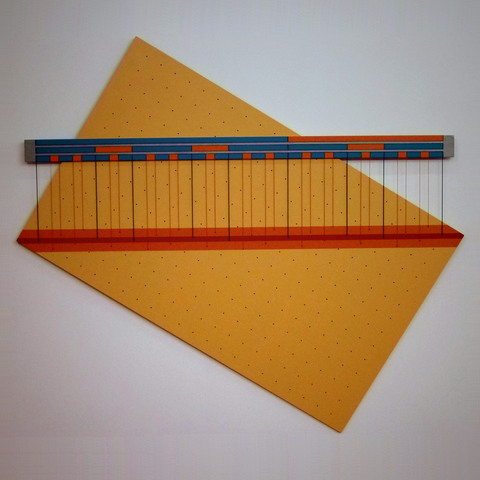
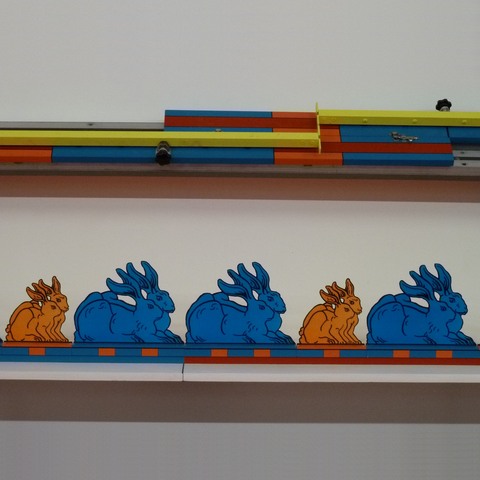
이 대상은 황금비 τ = 0.5 (√5 - 1) = 1.61803… 를 이용한 준주기(quasiperiodic) 수열을 만드는 두 가지 다른 방법을 보여줍니다.
위쪽의 막대에는 대입 방법(substitution method)이 묘사됩니다. 막대의 첫 번째 열에서 긴 파란색 구간 Lq와 짧은 주황색 구간 Sq의 길이 비율은 τ : 1입니다. 두 번째 열에서 이 둘 Lq 와 Sq는 더 작은 구간들로 대체되는데, L = Lq · τ^-3 and S = Sq · τ^-3 (메모: τ^-3 = 1/(τ^3) = 0.236…) 로 잡았을 때 Lq → L + S + L + S + L and Sq → L + S + L 이런 식으로 대체됩니다. 셋째 열에서 한번 더 반복을 통해 얻은 구간 L’과 S’는 역시 τ -3의 비율로 줄어듭니다.
준주기 수열을 만드는 또 다른 방법은 띠 사영 방법(stripe projection method)으로 불립니다. 노란 판의 정사각 격자의 경사각 φ는 tan φ = τ로 주어집니다. 수평 방향의 빨강/주황 줄무늬 속의 점들의 수직 사영은 대입 방법으로 얻어낸 수열과 완전히 일치하게 대응됩니다.
13세기 초에 피보나치(Leonardo Fibonacci)는 토끼 집단의 개체수를 계산하는 가상의 규칙을 서술하였습니다. 이 규칙은 어린 토끼들의 쌍과 어른 토끼들의 쌍들에 대한 준주기(quasiperiodic) 수열을 만들어 냅니다. 길이 S를 어린 토끼들의 쌍에, 길이 L을 어른 토끼들의 쌍에 대응시키면, 수열은 대입 방법에 의해 만들어진 것과 정확히 일치합니다.
사진 위쪽에 보이는 일차원의 준단위(quasi-cell)들이 순차적으로 준주기 수열을 만들어 갑니다. 노란색 미끄럼자들이 이어지는 성장을 결정합니다. 자들은 주기적인 평균 길이를 갖고 있습니다. 사진에서 보듯 이들의 끝점을 서로 연결하면, 준단위들의 작동 방식이 이 완벽한 준주기 수열을 성장시키는 원동력이 됩니다.
이 1차원 준단위는, 다음 세 체험물들의 주제인 빈틈 없는 10각형의 준결정 성장의 모형을 만드는 기초가 됩니다. 더욱 자세한 정보는 Wickerwork 갤러리 설명서(description booklet of the Wickerwork gallery, 독어/영어 제공)에서 찾아볼 수 있습니다.
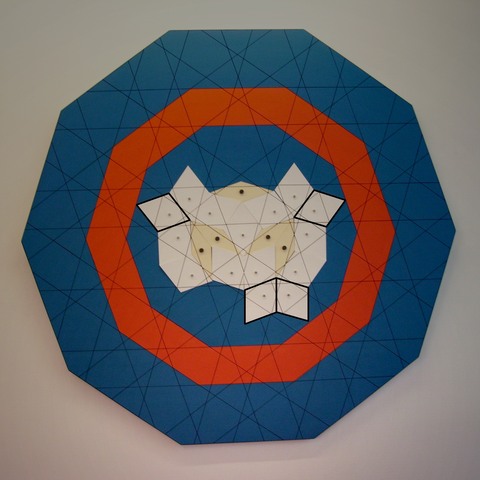
파란 십각형 위에 그려진 Ammann 격자는 수평으로 확장된 경계선을 가진 수직 피보나치 수열에 기초해 있습니다. 수직 피보나치 수열의 일차원 격자는 36°의 배수만큼 돌려진 4개의 복사본과 같이 비대칭적으로 중첩되어 놓여 Ammann 격자를 만들게 됩니다.
두꺼운 하얀색 도형과 보다 작은 노란 색조의 도형들이 십각형의 중심에 자석으로 고정되어 있는데, 이들은 펜로즈 마름모(Penrose rhomb)라 불리고 Ammann 격자의 절단으로 표시되어 있습니다. 이 펜로즈 마름모들의 “짝짓기 규칙”(matching rules)들이 이 선들이 마름모에서 마름모로 이어지게 뻗어나가는 방식을 결정합니다.
이렇게 펜로즈 타일링(Penrose tiling)이 마름모의 표시들이 십각형의 Ammann 격자에 연관딜 때 “수레바퀴”(cartwheel)라 불립니다. 하지만 위쪽의 두 검은 경계선의 마름모들은 짝짓기 규칙을 따르지 않으므로 “수레바퀴 체계”(cartwheel order)에 속하지 않습니다. 자유롭게 맞춰지는 펜로즈 타일링은 언젠가 짝짓기 규칙을 위반해야 한다는 사실을 증명할 수 있습니다. 아래쪽의 두 검은 경계선의 마름모들은 다른 타일 방법에 따라선 바르게 맞춰질 수 있는 마름모들입니다.
준결정의 성장의 수학적 표현을 펜로즈 마름모들의 짝짓기 규칙이나 관련된 번갈아 겹치는 단위체(Gummelt의 십각형)의 덮개 규칙(covering rules)만으로 설명하려면 항상 맞지 않는 부분이 생기게 됩니다.
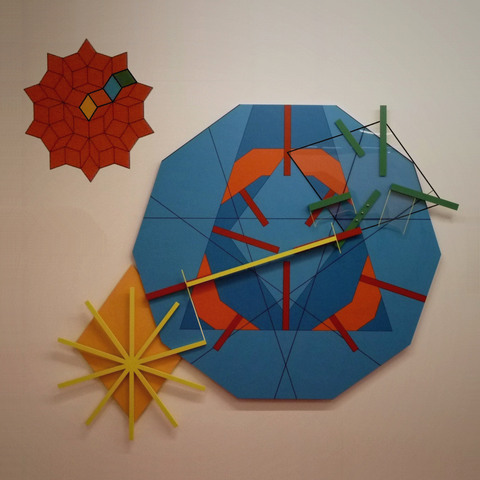
준주기 연쇄(quasiperiodic succession) 알고리즘도 순차적으로 작동하지만, 이는 각각의 준단위체 Q에 대한 두꺼운 마름모들을 조절하여 빈틈없는 수레바퀴 체계의 성장을 촉진시킵니다.
준단위체 Q에 주기적인 평균길이를 갖는 5개의 노란색 미끄럼자가 있습니다. 초기 단위체의 자들은 별 모양을 띠고 있습니다. 큰 파란색의 Q 준단위체는 좌상단에서 보이는 수레바퀴 체계의 파란 마름모와 관련이 있습니다. 여기서는 하나만의 자만이 표시되어 있고, 이는 빨간 쌍둥이 틀에 맞추며 유동적으로 움직일 수 있습니다. 자의 위치는 좌하단의 초기 단위체의 평행한 자에 의존합니다. 우측의 끝점 표시는 자의 위치를 평행한 회전고리에 연결되어 있는 우상단 검은 경계선 마름모의 초록색 틀에 옮길 수 있게 합니다. 그 위치는 좌상단 수레바퀴 체계의 초록 마름모와 관련되어 결정됩니다.
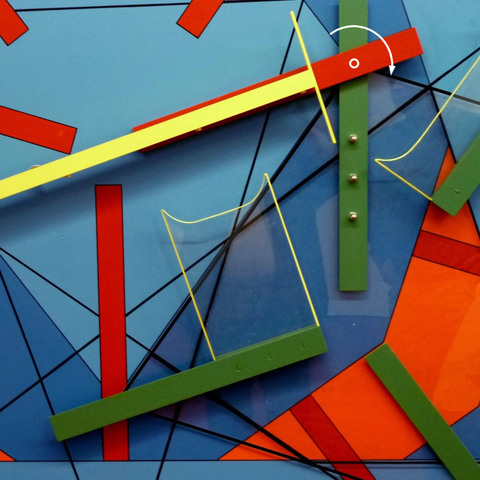
이 Q 준단위체의 세부모습에서, 아크릴 플렉시글라스 마름모의 위치는 이전 이미지의 것과 다릅니다. 하양 화살표는 마름모가 144° 회전한 방향을 말해줍니다. 하지만 이 두 자리 모두에서 Ammann 직선들을 연장할 수 있다는 것이 보장되기 때문에 둘 모두 짝짓기 규칙에 맞습니다.
이전 이미지에서 자의 우측 끝단 표시는 여기서는 보이지 않는 평행한 초록 틀의 자와 연결될 수 있습니다. 양끝점 모두가 노란 괄호로 표시된 평행 틀의 구간 속에 들어갈 수 있었기 때문입니다.
여기 보이는 마름모의 다른 위치에서는, 끝점이 노란 괄호로 표시된 공통 구간 밖에 존재합니다. 따라서 이 마름모 위치는 초기 단위체에 대해 상대적으로 혀옹되는 위치가 아닙니다. 준결정 연쇄 알고리즘(quasiperiodic succession algorithm)은 오로지 완벽한 수레바퀴 체계에 대응하는 위치만을 결정합니다. 수레바퀴 체계의 정의는 명확하고 무한합니다.
The recursive formula consists of 50 scale value equations. The ten blocks in the outer columns correspond to the ten possible rhombus neighborhoods hj which are shown beside the columns. a, b, c, d and e are the values of the five double scales of a quasicell Q. The double scales are rotated by 36° to one another. Each thick rhombus can be assigned a quasicell Q.
The five values of the start cell Q0 are infinitesimally small, i. e. μ0 = 10^–n, with lim n → ∞. If they are entered in the central block, the formula leads to four valid neighbours, h1*, h2*, h4 and h1 (because their five respective values are valid) and six invalid neighbours (because one or more of their respective values are invalid). Please note that an asterisk is used here instead of an overline to indicate an inverse operation.
The valid values of Q01*, Q02*, Q04 and Q01are entered in the central block of four new formula sheets whereby the next generation of neighbours can be calculated. This recursiv scheme creates step by step an error-free quasiperiodic cartwheel order, as required for such a growth model.
Submitted by IMAGINARY on
The new project “Oberwolfach meets IMAGINARY” funded by the Klaus Tschira Stiftung started! It is a three years project (2013 - 2016) with several work plans focusing on the communication of modern mathematics and current mathematical research. The core idea of this new project is to connect the Mathematisches Forschungsinstitut Oberwolfach, one of the most important mathematical research institutes worldwide, and IMAGINARY.
Mathematicians carrying out research at the institute are invited to become “content providers”, in particular to write the so called “Snapshots of Modern Mathematics”, i. e. texts about their current research for a broader public.
Another work plan will focus on “Media from Oberwolfach” connected to modern mathematics. Images, films, simulations and other software programs will be taken and re-designed to be used for general math communication. We are planning to create more exhibits for our IMAGINARY exhibitions and also our museum partners.
And of course, the IMAGINARY platform will be further extended and adapted to host these new media, and also to invite other research insttitutes to participate. A special workplan will be carried out for the creation of an international network of math communicators and math content providers.
The project is designed to promote the understanding and appreciation of modern mathematics and mathematical research in the general public world-wide.

Submitted by Bianca Violet on
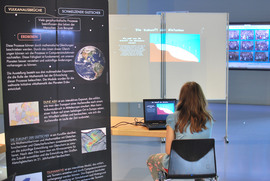
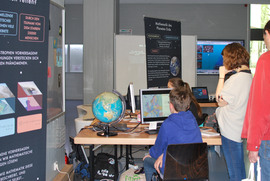
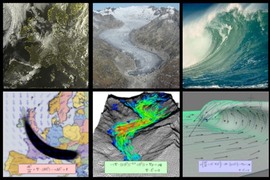
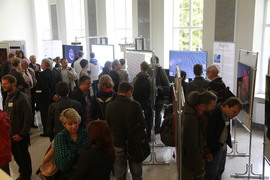
The three interactive stations on glaciers, volcanic ash and tsunamis will be presented, which include a lot of background information on the simulation of these natural phenomena and their mathematical models.
The exhibit “Dune Ash” of the University of Freiburg is a virtual simulation of a volcanic eruption. The calculation of the movement of an ash cloud is made visible for the visitors. “The future development of a glacier” of the Freie Universität Berlin explains how experts create models in order to predict glacier shifting. Finally, the exhibit “Tsunami” is a project from the University of Paris that shows a simulation of the evolution and computation of tsunami waves as well as a historical outline about the formation and the consequences of devastating tsunamis in the past.
1 pm - 4 pm


Submitted by Mikhail Rusakov on
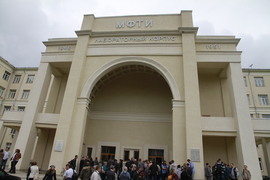
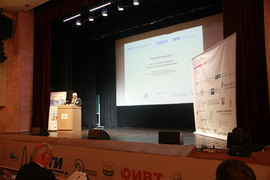
Opening: 7th September 2015, 12:15 PM


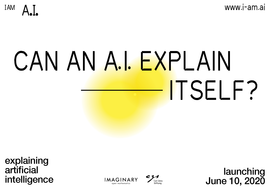
Can an AI explain itself? That is a question that many researchers are asking themselves right now. We think that - at least in some cases - the answer is “Yes!”.
On June 10 the interactive exhibition “I AM A. I. – explaining artificial intelligence” will be launched in a new digital format. Different “trails” introduce the visitor to core questions around artificial intelligence through means of images, videos, and experiments. The exhibits are targeted at everyone from the age of 12. From 2021 onwards, I AM A. I. will travel to several German cities as a physical exhibition (Jena, Heidelberg, Kaiserslautern).
The exhibition, supported by the Carl Zeiss Foundation, will include demonstrations and explanations of Artificial Intelligence using interactive exhibits, artworks, videos, and workshops. It will feature both new and established research in fields like machine learning, expert systems, general artificial intelligence and more. The exhibition will visit three German cities, for three months each.
About the Carl Zeiss FoundationThe Carl Zeiss Foundation’s mission is to create an open environment for scientific breakthroughs. As a partner of excellence in science, it supports basic research as well as application-orientated research and teaching in the MINT subject areas (mathematics, information technology, natural sciences and technical disciplines). Founded in 1889 by the physicist and mathematician Ernst Abbe, the Carl Zeiss Foundation is the oldest private science funding institution in Germany. It is the sole owner of Carl Zeiss AG and SCHOTT AG. Its projects are financed from the dividend distributions of the two foundation companies.
related links:
Call for partners and exhibits
Call for art projects

You can contact us at ai@imaginary.org.
Submitted by Andreas Gebert on
Monday-Saturday from 10:00-17:00 h