Buscar

Resultados de la búsqueda

Resultados totales: 127.

IMAGINARY goes North and East - upcoming exhibitions in Denmark, Russia and Norway

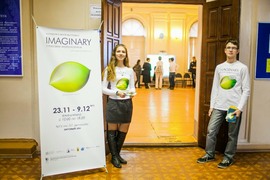
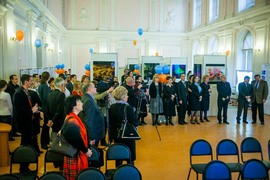
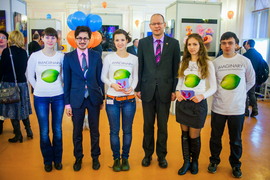
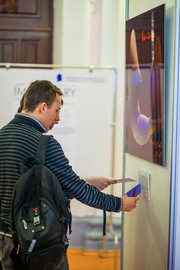
This Friday, April 5, a special IMAGINARY exhibition featuring sculptures and images will be shown for the first time in Denmark, at the Steno Science Museum in Aarhus, see here for the event info. It will be open until August 31, 2013. Then the exhibition series in Russia will find its continuation in a one week exhibition at Pushchino, a small town south of Moscow. It is the fifth exhibition in Russia, coordinated in collaboration with the German Embassy in Moscow (and some more are in the planning pipeline). In May IMAGINARY will be honoured to travel to Norway - also a first-timer - to be shown after the celebrations of the Abel prize ceremony in Oslo. It will be presented in a science museum in Trondheim - more detailscon be found here.
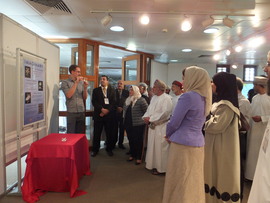
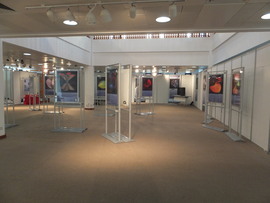
And if you are in Spain (and up for the Camino de Santiago), don’t forget to stop by the University Church next to Santiago de Compostela’s cathedral to see the ongoing RSME-IMAGINARY there - open until May 16, 2013.

Image Collection: 
Files: 

IMAGINARY Israel announced

On the occasion of the 50 year long diplomatic relations between Germany and Israel, the project IMAGINARY Israel by the Mathematisches Forschungsinstitut Oberwolfach (MFO) will be announced in conjuction with a visit by German Federal Minister of Education and Research Johanna Wanka at the Weizmann Institute of Science on Feburary 10. The project consists of two mathematics exhibitions for the general public and two workshops mainly for young mathematicians from Germany and Israel.

Within this project, IMAGINARY is given the opportunity to collaborate with an excellent science communication center (the Clore Garden of Science The Davidson Institute of Science Education, the Weizmann Institute of Science) in order to share experiences in staging inspiring exhibitions and communicating current mathematics research to the general public. The collaboration will lead to the first ever IMAGINARY exhibition being shown in Israel during the summer of 2015 at the Clore Garden of Science in Rehovot , followed by a second exhibition shown in Tel Aviv towards the end of 2015 and the beginning of 2016. 

Watch out for the exact date announcements of the two planned exhibitions!

We are pleased to announce that IMAGINARY Israel has received funding from the Federal Ministry of Education and Research (BMBF) and is organized within the “Research in Germany” campaign of the BMBF, with the aim of strengthening the traditionally very good mathematical research collaborations between the two countries.
Image Collection: 
Files: 

STEAM Hub - Breaking-the-Ice

If you would like to participate, please fill in the registration form

Please bring along your ideas, you can leave them already via the idea brainstorming form.
You can also share your ideas, even if you are not able to participate. 

At the STEAM Hub Innovation Forum (31.5 - 1.6.2018, in Berlin, details to be announced shortly) we will then take a selection of ideas one step further into the market!

Time and Place: 
Jueves, Abril 12, 2018 - 00:00 hasta 23:45
Venue: 
InnovationLabs.Berlin
Crellestr. 37
10827 Berllin
Germany
Coordinates: 
POINT (13.361 52.48818)
Opening Hours: 

17:30-20:30

Image Collection: 
Credits: 
Supported by the German Federal Ministry of Education and Research (BMBF).

PyFWI - An interactive Software for the Simulation of Seismic Waves

Descripción

Description: 

The software is designed to illustrate maritime seismic imaging and includes

  • a graphic tool to play around with wave reflections
  • a simulation environment demonstrating wave propagation
  • an interactive selection of sources and receivers for seismic imaging
  • several explanations of the basic ideas
  • some information on mathematics and numerics
  • many additional features to discover

For more details and a demonstration video see our website at http://www. waves. kit.edu/pyfwi.php

Créditos

Credit Text: 
This interactive software is realized by Daniele Corallo, Johannes Ernesti, Kevin Ganster, Christian Rheinbay, Christian Wieners on the basis of the open source toolbox PySIT (pysit.org) developed by Russell J. Hewett and Laurent Demanet.
Supported by: 
We gratefully acknowledge the support of the German Research Foundation (DFG) by CRC 1173 in the subprojects on numerical wave propagation and seismic imaging. The illustrations are provided by our project partner Thomas Bohlen from geophysics.

Adjuntos

Embed External Video: 
Contributor(s): 
Johannes Ernesti, Christian Wieners
Files: 
Main File: 
Main File Description: 
PyFWI - An interactive Software for the Simulation of Seismic Waves
Image Collection: 
Applet height: 
800px

Exhibition/User:

Licenses: 

License:

MatchTheNet

Descripción

Description: 

In each round of the game you will see some polytopes on the top half of the window.

You can rotate them to look at them from all sides.

In the bottom half you will see the same number of planar nets.
These are unfoldings of polytopes into the plane.
The goal is to match the nets to the polytopes.
You can switch any pair of nets by moving one over the other.

MatchTheNet is available in English, French, and German, it features 7 levels of difficulties for a number of 2 up to 5 polytopes. The program is well suited for temporary or permanent installations in exhibitions and science museums.

MatchTheNet is based on polymake, which is open source software for research in polyhedral geometry.  It deals with polytopes, polyhedra and fans as well as simplicial complexes, matroids, graphs, tropical cycles, and more.

Créditos

Credit Text: 
Idea & Development: Michael Joswig, Georg Loho, Benjamin Lorenz, Rico Raber & the polymake team (www.polymake.org/doku.php/team), license: CC-BY-NC-ND-3.0. Stopwatch icon made by Dario Ferrando from www.flaticon.com (CC BY 3.0). Checkered icon and Drag Flick icon made Freepik from www.flaticon.com (CC BY 3.0). JavaScript 3D library three.js made by three.js authors (MIT license). JavaScript drag and drop library interact.js made by Taye Adeyemi (MIT license).

Adjuntos

Icon: 
Embed External Video: 
Contributor(s): 
Files: 
Exhibition Poster MatchTheNet (PDF)
Polyhedra Nets (PDF)
Polyhedra Images (PDF)
Image Collection: 
Launch Code : 
Applet height: 
800px

Exhibition/User:

Licenses: 

License:

conform!

How can you make good flat maps of the round earth?’ Our story begins with Mercator’s world map of 1569, the first angle-preserving (or ‘conformal’) world map. His idea fell on fruitful soil, from which a new branch of mathematics has developed. The movie shows some of the highlights of this development, yielding a series of elegant visual forms which arise as ‘conformal maps’ on a variety of surfaces in 2- and 3-D. Featuring non-technical language, a simple aesthetic, compelling animation, and an original score, the movie builds an accessible bridge from everyday experience to a beautiful but little-known mathematical theory that continues to bear technological fruit today in fields such as computer graphics and architecture.

More information on the film can be found at conformmovie.de.

If you would like to show the film in a larger space and need a higher resolution copy (1080p) of the video, please contact Charles Gunn here. Also if you would like to show the film in German, French, Italian, or Russian.

Embed External Video: 
Credits Collection: 
A short film from the Discrete Geometry Group at Technical University Berlin on conformal maps.
Alexander Bobenko
Charles Gunn
Alexander Bobenko
Boris Springborn
Stefan Sechelmann
Charles Gunn
Charles Gunn
Luis Vera
Charles Gunn
Helene Seidl
jreality.de
Charles Gunn
Files: 
Image Collection: 

Exhibition/User:

About

IMAGINARY es una plataforma dedicada a la matemática abierta e interactiva. Contiene una variedad de contenido que puede ser usado en escuelas, hogares, museos, exposiciones, o en eventos y actividades de prensa. El contenido principal de IMAGINARY consiste en programas interactivos y galerías de imágenes.

La plataforma permite integrar fácilmente nuevos contenidos, por ejemplo temas adicionales sobre matemáticas, o exposiciones. Uno de los principales objetivos de IMAGINARY es permitirles a ustedes, a la comunidad, participar e involucrarse con sus ideas. La idea principal es que los módulos se crean dentro de la comunidad, y las exposiciones se organizan de forma independiente.

Este concepto y la plataforma se desarrollaron a partir de la exposición IMAGINARY original, que comenzó en el año 2008 y desde entonces ha recorrido más de 80 ciudades en todo el mundo. Este éxito enorme y el crecimiento de la comunidad fueron los que llevaron a la creación de la plataforma.

IMAGINARY es un proyecto del Mathematisches Forschungsinstitut Oberwolfach (Director: Prof. Dr. Gerhard Huisken). La plataforma es financiada por Klaus Tschira Stiftung (2011–2013). La Real Sociedad Matemática Española realiza la edición del portal en español.

File(s) with Language: 

Versión española de la plataforma

Bienvenidos a la version española de «IMAGINARY - open mathematics»! Se puede acceder usando el nuevo selector de idiomas en la cabeza de la pagina o con el enlace directo de www. imaginary.org/es. Todos los contenidos principales de exposiciones han sido traducidos e invitamos a todos colaboradores de juntarse a nuestro equipo de traductores para ayudarnos a traducir los contenidos de los usuarios. La edición española de la pagina ha sido implementada y coordinada por la Real Sociedad Matemática Española (RSME). La RSME ya organizó mas de 15 exposiciones en ciudades en España y dos instalaciones temporarios en museos en Madrid y Barcelona.

Estamos tambien preparando la plataforma en alemán, francés y portugués. Les mantenemos al tanto!

Image Collection: 
Files: 

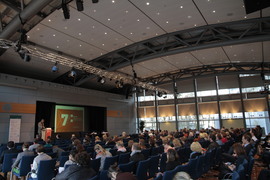
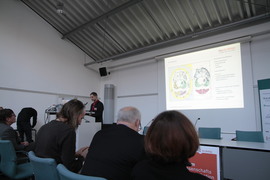
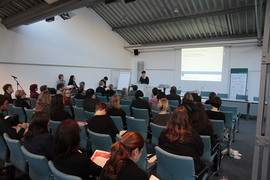
Panel at 8th Forum Wissenschaftskommunikation

The discussion panel will be on Tuesday Dec 1, from 5pm - 6:30pm.

Abstract of the panel (in German):

Interdisziplinäre und partizipative Formate stellen einen wachsenden Trend in der Wissenschaft, Kunst und Kommunikation dar und vereinen Kreative unterschiedlicher Fachrichtungen: wissenschaftliche Konferenzen werden zu partizipativen Festivals von ForscherInnen und KünstlerInnen, Ausstellungen werden von WissenschaftlerInnen und dem Publikum gemeinsam entworfen und eigenständig organisiert und neue Museen zeigen nicht nur Kunst & Wissenschaft, sondern erforschen selbst experimentelle Museums-Technologien für andere Museen. 

Die junge Szene boomt, ist international ausgerichtet und bringt viele neue Initiativen und Akteure hervor – innerhalb und außerhalb der Wissenschaftsinstitutionen. Ist das eine Chance für die Wissenschaftskommunikation, um neue Zielgruppen zu erschliessen? Wie ist mit den neuen Initiativen und Formaten umzugehen? Wie können diese von Wissenschaftseinrichtungen genutzt werden, um einen Mehrwert für die Vermittlung von Wissenschaft zu schaffen? Diese Session gibt beispielhaft Einblick in nationale und internationale Projekte und Entwicklungen und diskutiert die Möglichkeiten im Rahmen der Wissenschaftskommunikation von Forschungseinrichtungen und Universitäten.

Time and Place: 
Lunes, Noviembre 30, 2015 - 00:00 hasta Miércoles, Diciembre 2, 2015 - 23:45
Venue: 
Meistersingerhalle
Münchener Straße 19
90478 Nürnberg
Germany
Coordinates: 
POINT (11.1022915 49.4369085)
Files: 
Image Collection: 
Embed External Video: 
Credits: 
Organised by Wissenschaft im Dialog.

La La Lab – the Mathematics of Music at MAINS in Heidelberg

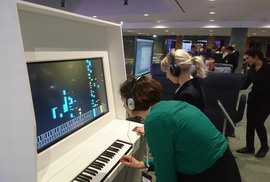
Conceived in collaboration with experts in current research of music and mathematics, La La Lab mixes a laboratory format with interactive exhibits to present you with the stunning connections between mathematics and music pushing the boundaries of musical creativity and mathematical knowledge. It features more than a dozen interactive exhibits with newly developed software, images, 3d prints, hands-on installations, projections and a special reading and listening area. The exhibition is also part of the German Science Year of Artificial Intelligence 2019 presenting several exhibits on AI and music.

 The exhibition pivots over three axis (mixed inside the Lab):

  • Music theory.
    Learning what tools build music, and how these tools are used to create art. Basic concepts and historical comments.

  • Current research.
    The latest trends of research in the connection of maths and music. Artificial Intelligence, theoretical and new instruments, classification and composition tools.

  • Art and entertainment.
    A joyful display of artworks from artists and mathematicians in the field. Talks/concerts at scheduled events.

The exhibition is created by IMAGINARY, with the scientific and artistic advisorship of Moreno Andreatta (IRCAM Paris, Univ. Strasbourg), Thomas Noll (ESMUC Barcelona), Luisa Pereira and Manuela Donosa (New York) and Jürgen Richter-Gebert (TU Munich); and with the generous contributions of more than 20 artists and scientists working in the field.

The exhibition is presented by the Heidelberg Laureate Forum Foundation (HLFF), who created MAINS, a special event and exhibition venue dedicated to mathematics and informatics. The former showroom of the “Heidelberger Druckmaschinen” offers plenty of space to raise public awareness of the disciplines’ importance for society.

The exhibition was made possible by the Klaus Tschira Stiftung. It is supported by the Technical University of Munich.


Time and Place: 
Viernes, Mayo 17, 2019 - 00:00 hasta Domingo, Diciembre 20, 2020 - 23:45
Venue: 
MAINS
Kurfürsten-Anlage 52
69115 Heidelberg
Germany
Coordinates: 
POINT (8.6793448 49.405424)
Opening Hours: 

closed during September 2020

opening hours:

August 2020:
Saturday and Sunday: 1- 6 pm

October-December 2020:
Thursday and Friday: 3 - 6 pm
Weekends and Holidays: 1 - 6 pm

entrance is free

guided tours every Sunday at 3 pm

Files: 
Short concept (PDF, English)
Exhibition poster (PDF, English)
Exhibition booklet (PDF, English)
Image Collection: 
Credits: 
Moreno Andreatta
Thomas Noll
Jürgen Richter-Gebert
Luisa Pereira
Manuela Donosa
Andreas Matt (Direction)
Kathrin Unterleitner (Project Management)
Daniel Ramos (Curation)
Bianca Violet (Content)
Christian Stussak (Software)
Eric Londaits (Software)
Sebastián Uribe (Software)
Malte Westphalen (Design)
Konrad Renner (Design)
Lukas Reck (Production)
Daniel Weiss (Production)
Tobias Hermann (Hardware)
Magdalena Hreczynska (Assistance)
Antonia Mey (Assistance)
Moreno Andreatta, Corentin Guichaoua, Philipp Legner
Ryan Cashman
Luisa Pereira, Manuela Donoso
Jürgen Richter-Gebert, Aaron Montag, Patrick Wilson, Konrad Heidler
Vítor Rolla, Pedro Arthur, José Ezequiel Soto Sánchez
Neil Sloane, Georg Fischer, William Cheswick, Charles Greathouse
Neil Thapen
Thomas Noll
Gerhard Widmer, Stephan Balke, Florian Henkel, Carlos Eduardo Cancino Chacón
Ricardo Dodds
Gilles Baroin
CNRS/IRCAM/Sorbonne University
USIAS (University of Strasbourg Institute for Advanced Study)
IRMA/University of Strasbourg
Team der Heidelberg Laureate Forum Foundation
Technische Universität München
Springer Publishing House
The Looking Glass
Taylor & Francis Publishing House
Alba Málaga Sabogal, Yann Orlarey, Catinca Dumitrascu, Tero Parviainen
Google Magenta Team, Exploratorium San Francisco

Páginas