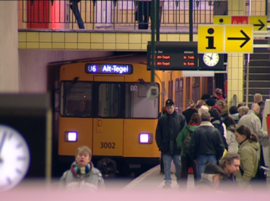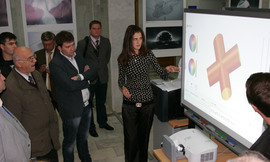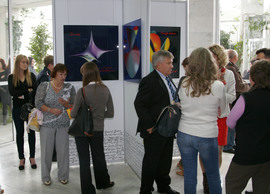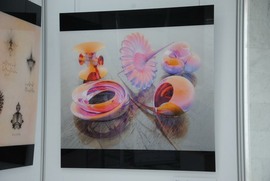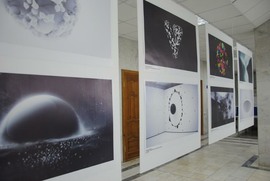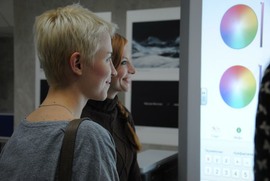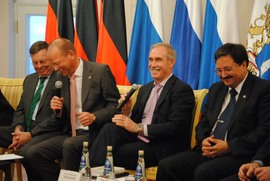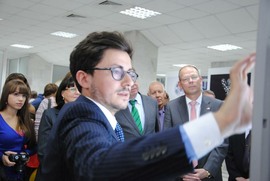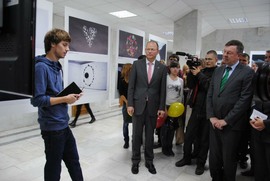
IMAGINARY in Moscow
Enviado por Mikhail Rusakov el
Daily from 11.00 till 18.00h


Enviado por Mikhail Rusakov el
Daily from 11.00 till 18.00h


Enviado por IMAGINARY el
El LGM2014 tendrá lugar del 2 al 5 de abril en Leipzig, Alemania, y contará con talleres para artistas e informáticos. 90 estimulantes charlas servirán de escaparate de nuevos y futuros proyectos como Tupi, Kune, Synfig, Laidout, así como para proyectos consolidados como GIMP, Krita, Inkscape, Scribus y Blender.
Desde 2006, el Libre Graphics Meeting es el principal acontecimiento donde desarrolladores de software libre para artistas se reúnen para trabajar en los mismos objetivos. El LGM es de acceso libre y abierto a todo el mundo.
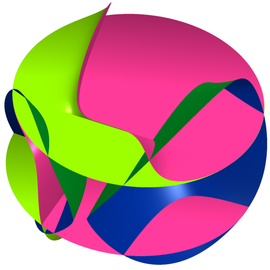
El programa SURFER será presentado en el Libre Graphics Meeting. Nuestro trazador de rayos en tiempo real para superficies algebraicas se presentará por primera vez a la comunidad informática de gráficos en código abierto. La charla será el 2 de abril, a las 17:00 por Christian Stussak, desarrollador de SURFER.
Resumen de la charla: «SURFER is an open source program to visualize algebraic surfaces in real-time. It was developed for an interactive installation at the IMAGINARY exhibition for the German Year of Mathematics 2008 and was then extended and used in more than 110 exhibitions in 23 countries: for museum installations, schools and home use. The program is a bridge between art and mathematics and can be used to create beautiful pictures while at the same time exploring and learning the underlying mathematics. To create an image you enter a polynomial equation, for example x^2 − x^3 + y^2 − z = 0. SURFER then immediately calculates the points in space that satisfy this equation and displays them using ray tracing and an optimized root finder. In this presentation the program is introduced with many examples.»


Enviado por Andreas Gebert el


The workshop is based on digital modules and analogue games and discussions: visit restaurants in a new city and understand the difference between Exploration and Exploitation, follow us on a treasure hunt via gradient descent and find strategies to always win in the Chinese Game Room. In the mood for discussions? Download the discussion game “Blickwinkel KI”!
All material of the workshop is available under an open source license. Please let us know if you re-use material for your own workshops or have any feedback to further extend the workshop content.
Workshop Materia:

Enviado por Antonia Mey el
This exhibition is part of a project funded by the German Ministry of Education and Research under the brandname Research in Germany. This is the first of two IMAGINARY exhibitions in Israel in 2015. The second exhibition will be at Bar Ilan University towards the end of the year.
To find out more about the IMAGINARY Isarel project, checkout the project page and watch this space for more information in the future.
Sunday - Thursday 9:00 - 17:00
Further information on the website.


The STEM and Arts (STEAM) Hub (MINT&ART) project is an initiative under the “SMEs for Innovation“ pillar of the German Federal Ministry of Education and Research (BMBF). It aims to provide small and medium-sized enterprises (SMEs) in the fields of science marketing and media, with better prerequisites for developing their own innovation activities as well as new business models. These activities would in turn aspire to make science subjects such as mathematics and computer science attractive to young people; thus encouraging them to pursue education and careers in the mathematical sciences or technical fields.
The initiative will support the cooperation between business and science by establishing networks that lead to sustainable strategic alliances. The network will feature science museums, academic and research institutions, professional societies, companies and foundations. A central element of this initiative, is a two-day ‘Innovation Forum’ that will highlight innovative ideas with strong business plans, which would stimulate the formation of successful co-operations within and outside this network, as well as the terms of reference for the network.
Project GoalsGoals of the STEAM Hub project:
Establish a network of small and medium-sized enterprises (SMEs) with outreach activities in STEAM fields
Develop and promote ideas and technologies for novel and complex scientific exhibits (physical, interactive and virtual) in STEAM disciplines, in cooperation with SMEs and scientific institutions
Create an open web platform as a modern tool for science communication and science management (information and knowledge exchange, network for joint projects, marketing platform for own products)
Identify ways of making STEAM disciplines attractive to young audiences
Organize an ‘Innovation Forum’ with participating SMEs and other partners
Project Innovation Themes
Four innovation categories are planned:
Hardware innovations (design and implementation of mechanical technologies)
Software innovations (creation of software-based exhibits, educational games, operating systems for interactive museums)
Hot topics (content and technologies trends, exhibits on algorithms, big data, bioinformatics, AI, networked systems, data security, mathematics & music, etc.)
Marketing innovations (type of mediation, e. g. interactivity, citizen science, augmented/virtual reality, crowd science communication)

For further information, please write to steamhub@imaginary.org
Enviado por Guillaume Jouvet el
El matemático calcula el movimiento de hielo utilizando ecuaciones complejas, que sólo se pueden aproximar por simulaciones por ordenador. Por otro lado, el glaciólogo utiliza los datos de las precipitaciones y de las temperaturas con el fin de calcular la acumulación y derretimiento del hielo. Con toda la información disponible, la del matemático y la del glaciólogo, se construye un método para simular la evolución de los glaciares con el tiempo.
Como una prueba de validez, el método reconstruye correctamente el comportamiento del glaciar Ródano (Suiza) a lo largo del siglo XX. Se exploran varios escenarios climáticos posibles en el futuro, incluyendo un probable calentamiento global y un enfriamiento global improbable. Como resultado, cada escenario conduce a predicciones muy diferentes, desde la desaparición del glaciar antes de 2100 a un crecimiento sustancial de la lengua glaciar, como se observó durante la pequeña edad de hielo.
La película está disponible en inglés, francés y alemán.

Enviado por Bianca Violet el
There will be a big IMAGINARY exhibition in Heidelberg, Germany, July 20 - August 10!
The Kulturhaus Karlstorbahnhof is an attractive location, which even has its own movie theater.
There will be four exhibition stations:
It will be the first IMAGINARY exhibition in Heidelberg and is organized in collaboration with the Heidelberg Laureate Forum Foundation (HLFF), which hosts the annual Heidelberg Laureate Forum. Find a German description of the exhibition here.
There will also be a math film festival at the Karlstorbahnhof during the first week of the exhibition.
Come and join us in Heidelberg!

Enviado por Guillaume Jouvet el
The captured material was used to analyse the calving activity of the Bowdoin Glacier in 2015 by combining satellite images, UAV (unmanned aerial vehicle) photogrammetry and ice flow modelling. In particular, a high-resolution displacement field is inferred from UAV orthoimages taken immediately before and after the initiation of a large fracture, which induced a major calving event. A detailed analysis of the strain rate field allows to accurately map the path taken by the opening crack.
Read more about the scientific results here.
The film as well as the study demonstrates that the combination of UAV photogrammetry and ice flow modelling is a promising tool to horizontally and vertically track the propagation of fractures responsible for large calving events.
Subtitles are available in French, German and English in the file section below.

Enviado por Bianca Violet el
As part of the ‘Day of Foundations’, we present background info, challenges, and insider stories about developing I AM A. I. in an online video meeting (in German).
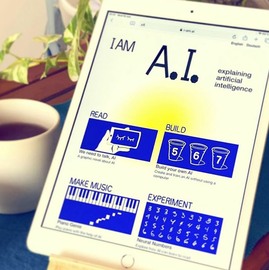
Click here to particpate in the meeting via zoom. (start at 12 pm)The digital exhibition format I AM A. I. pursues the key questions relating to artificial intelligence in five “trails”: How does a neural network learn? Does artificial intelligence make mistakes? What does ‘training data’ mean? The trails contain software programs, pictures, videos, experiments to use at home, and explanatory texts. The recognition of handwriting is trained, board games are played with an AI, and one of the most important methods of artificial intelligence, gradient descend, is illustrated. In addition, the contents of the exhibition will be deepened together with an exhibition tutor in an interactive video format.
We offer virtual tours free of charge for school classes. Please send inquiries to ai@imaginary.org
The digital exhibition concept was developed because the traveling exhibition I AM A. I., planned for 2020, had to be postponed due to Covid-19.
From 2021 the complete exhibition with further exciting exhibits can be visited as a physical traveling exhibition in Jena, Heidelberg, and Kaiserslautern.
online event: 12:00 - 13:00