Buscar

Resultados de la búsqueda

Resultados totales: 127.

conform!

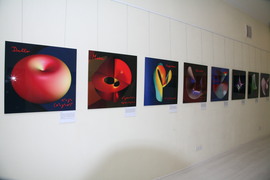
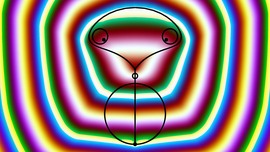
How can you make good flat maps of the round earth?’ Our story begins with Mercator’s world map of 1569, the first angle-preserving (or ‘conformal’) world map. His idea fell on fruitful soil, from which a new branch of mathematics has developed. The movie shows some of the highlights of this development, yielding a series of elegant visual forms which arise as ‘conformal maps’ on a variety of surfaces in 2- and 3-D. Featuring non-technical language, a simple aesthetic, compelling animation, and an original score, the movie builds an accessible bridge from everyday experience to a beautiful but little-known mathematical theory that continues to bear technological fruit today in fields such as computer graphics and architecture.

More information on the film can be found at conformmovie.de.

If you would like to show the film in a larger space and need a higher resolution copy (1080p) of the video, please contact Charles Gunn here. Also if you would like to show the film in German, French, Italian, or Russian.

Embed External Video: 
Credits Collection: 
A short film from the Discrete Geometry Group at Technical University Berlin on conformal maps.
Alexander Bobenko
Charles Gunn
Alexander Bobenko
Boris Springborn
Stefan Sechelmann
Charles Gunn
Charles Gunn
Luis Vera
Charles Gunn
Helene Seidl
jreality.de
Charles Gunn
Files: 
Image Collection: 

Exhibition/User:

About

IMAGINARY es una plataforma dedicada a la matemática abierta e interactiva. Contiene una variedad de contenido que puede ser usado en escuelas, hogares, museos, exposiciones, o en eventos y actividades de prensa. El contenido principal de IMAGINARY consiste en programas interactivos y galerías de imágenes.

La plataforma permite integrar fácilmente nuevos contenidos, por ejemplo temas adicionales sobre matemáticas, o exposiciones. Uno de los principales objetivos de IMAGINARY es permitirles a ustedes, a la comunidad, participar e involucrarse con sus ideas. La idea principal es que los módulos se crean dentro de la comunidad, y las exposiciones se organizan de forma independiente.

Este concepto y la plataforma se desarrollaron a partir de la exposición IMAGINARY original, que comenzó en el año 2008 y desde entonces ha recorrido más de 80 ciudades en todo el mundo. Este éxito enorme y el crecimiento de la comunidad fueron los que llevaron a la creación de la plataforma.

IMAGINARY es un proyecto del Mathematisches Forschungsinstitut Oberwolfach (Director: Prof. Dr. Gerhard Huisken). La plataforma es financiada por Klaus Tschira Stiftung (2011–2013). La Real Sociedad Matemática Española realiza la edición del portal en español.

File(s) with Language: 

Versión española de la plataforma

Bienvenidos a la version española de «IMAGINARY - open mathematics»! Se puede acceder usando el nuevo selector de idiomas en la cabeza de la pagina o con el enlace directo de www. imaginary.org/es. Todos los contenidos principales de exposiciones han sido traducidos e invitamos a todos colaboradores de juntarse a nuestro equipo de traductores para ayudarnos a traducir los contenidos de los usuarios. La edición española de la pagina ha sido implementada y coordinada por la Real Sociedad Matemática Española (RSME). La RSME ya organizó mas de 15 exposiciones en ciudades en España y dos instalaciones temporarios en museos en Madrid y Barcelona.

Estamos tambien preparando la plataforma en alemán, francés y portugués. Les mantenemos al tanto!

Image Collection: 
Files: 

Panel at 8th Forum Wissenschaftskommunikation

The discussion panel will be on Tuesday Dec 1, from 5pm - 6:30pm.

Abstract of the panel (in German):

Interdisziplinäre und partizipative Formate stellen einen wachsenden Trend in der Wissenschaft, Kunst und Kommunikation dar und vereinen Kreative unterschiedlicher Fachrichtungen: wissenschaftliche Konferenzen werden zu partizipativen Festivals von ForscherInnen und KünstlerInnen, Ausstellungen werden von WissenschaftlerInnen und dem Publikum gemeinsam entworfen und eigenständig organisiert und neue Museen zeigen nicht nur Kunst & Wissenschaft, sondern erforschen selbst experimentelle Museums-Technologien für andere Museen. 

Die junge Szene boomt, ist international ausgerichtet und bringt viele neue Initiativen und Akteure hervor – innerhalb und außerhalb der Wissenschaftsinstitutionen. Ist das eine Chance für die Wissenschaftskommunikation, um neue Zielgruppen zu erschliessen? Wie ist mit den neuen Initiativen und Formaten umzugehen? Wie können diese von Wissenschaftseinrichtungen genutzt werden, um einen Mehrwert für die Vermittlung von Wissenschaft zu schaffen? Diese Session gibt beispielhaft Einblick in nationale und internationale Projekte und Entwicklungen und diskutiert die Möglichkeiten im Rahmen der Wissenschaftskommunikation von Forschungseinrichtungen und Universitäten.

Time and Place: 
Lunes, Noviembre 30, 2015 - 00:00 hasta Miércoles, Diciembre 2, 2015 - 23:45
Venue: 
Meistersingerhalle
Münchener Straße 19
90478 Nürnberg
Germany
Coordinates: 
POINT (11.1022915 49.4369085)
Files: 
Image Collection: 
Embed External Video: 
Credits: 
Organised by Wissenschaft im Dialog.

La La Lab – the Mathematics of Music at MAINS in Heidelberg

Conceived in collaboration with experts in current research of music and mathematics, La La Lab mixes a laboratory format with interactive exhibits to present you with the stunning connections between mathematics and music pushing the boundaries of musical creativity and mathematical knowledge. It features more than a dozen interactive exhibits with newly developed software, images, 3d prints, hands-on installations, projections and a special reading and listening area. The exhibition is also part of the German Science Year of Artificial Intelligence 2019 presenting several exhibits on AI and music.

 The exhibition pivots over three axis (mixed inside the Lab):

  • Music theory.
    Learning what tools build music, and how these tools are used to create art. Basic concepts and historical comments.

  • Current research.
    The latest trends of research in the connection of maths and music. Artificial Intelligence, theoretical and new instruments, classification and composition tools.

  • Art and entertainment.
    A joyful display of artworks from artists and mathematicians in the field. Talks/concerts at scheduled events.

The exhibition is created by IMAGINARY, with the scientific and artistic advisorship of Moreno Andreatta (IRCAM Paris, Univ. Strasbourg), Thomas Noll (ESMUC Barcelona), Luisa Pereira and Manuela Donosa (New York) and Jürgen Richter-Gebert (TU Munich); and with the generous contributions of more than 20 artists and scientists working in the field.

The exhibition is presented by the Heidelberg Laureate Forum Foundation (HLFF), who created MAINS, a special event and exhibition venue dedicated to mathematics and informatics. The former showroom of the “Heidelberger Druckmaschinen” offers plenty of space to raise public awareness of the disciplines’ importance for society.

The exhibition was made possible by the Klaus Tschira Stiftung. It is supported by the Technical University of Munich.


Time and Place: 
Viernes, Mayo 17, 2019 - 00:00 hasta Domingo, Diciembre 20, 2020 - 23:45
Venue: 
MAINS
Kurfürsten-Anlage 52
69115 Heidelberg
Germany
Coordinates: 
POINT (8.6793448 49.405424)
Opening Hours: 

closed during September 2020

opening hours:

August 2020:
Saturday and Sunday: 1- 6 pm

October-December 2020:
Thursday and Friday: 3 - 6 pm
Weekends and Holidays: 1 - 6 pm

entrance is free

guided tours every Sunday at 3 pm

Files: 
Short concept (PDF, English)
Exhibition poster (PDF, English)
Exhibition booklet (PDF, English)
Image Collection: 
Credits: 
Moreno Andreatta
Thomas Noll
Jürgen Richter-Gebert
Luisa Pereira
Manuela Donosa
Andreas Matt (Direction)
Kathrin Unterleitner (Project Management)
Daniel Ramos (Curation)
Bianca Violet (Content)
Christian Stussak (Software)
Eric Londaits (Software)
Sebastián Uribe (Software)
Malte Westphalen (Design)
Konrad Renner (Design)
Lukas Reck (Production)
Daniel Weiss (Production)
Tobias Hermann (Hardware)
Magdalena Hreczynska (Assistance)
Antonia Mey (Assistance)
Moreno Andreatta, Corentin Guichaoua, Philipp Legner
Ryan Cashman
Luisa Pereira, Manuela Donoso
Jürgen Richter-Gebert, Aaron Montag, Patrick Wilson, Konrad Heidler
Vítor Rolla, Pedro Arthur, José Ezequiel Soto Sánchez
Neil Sloane, Georg Fischer, William Cheswick, Charles Greathouse
Neil Thapen
Thomas Noll
Gerhard Widmer, Stephan Balke, Florian Henkel, Carlos Eduardo Cancino Chacón
Ricardo Dodds
Gilles Baroin
CNRS/IRCAM/Sorbonne University
USIAS (University of Strasbourg Institute for Advanced Study)
IRMA/University of Strasbourg
Team der Heidelberg Laureate Forum Foundation
Technische Universität München
Springer Publishing House
The Looking Glass
Taylor & Francis Publishing House
Alba Málaga Sabogal, Yann Orlarey, Catinca Dumitrascu, Tero Parviainen
Google Magenta Team, Exploratorium San Francisco

IMAGINARY es parte del Año de la Ciencia 2014

Cómo obtenemos información, cómo vivimos, cómo nos comunicamos… todo esto ha cambiado radicalmente en las últimas dos décadas. Las nuevas tecnologías digitales son fundamentales en nuestra vida diaria y nos ofrecen un sinfín de posibilidades. Algunos lo llaman la revolución digital, que sería comparable a hitos como la invención de la imprenta. El Año de la Ciencia 2014 «La Sociedad Digital» nos enseña cómo la investigación puede proporcionar nuevas maneras de promover este desarrollo centrado en el impacto de la revolución digital.
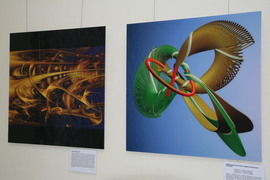
Una de las maneras en que IMAGINARY comunicamos la ciencia es a través de nuestra plataforma digital. Las exposiciones se desarrollan junto a los usuarios, que son la sociedad misma. También le damos un espacio a los expositores digitales y al intercambio de conocimiento e información. A todos los efectos, IMAGINARY es «divulgación de la ciencia 2.0».

Tendremos numerosos eventos de promoción de la comunicación ciencia-público. Nuestra exposición «Matematicas del planeta Tierra» en el Deutsches Technikmuseum en Berlín es uno de ellos. Se inaugura esta semana el jueves 27 de marzo, y permanecerá abierta hasta el 30 de junio.


Image Collection: 
Files: 

Entdeckerbox

The Mathematics behind the various pieces of content can be discovered playfully and interactively – it is yours to conjecture and construct new experiences. The modules are designed to prompt you to stretch your mathematical thinking and invite further exploration beyond the content of the discovery box.  

Such an investigative approach, be it with teachers, with a mathematician, or alone with the help of books, articles or even a white sheet of paper is an integral part of what it means to think mathematically. As such, the discovery box is designed particularly to appeal teachers and students, or the general public with an interest in Mathematics. 

The IMAGINARY project is funded by Klaus Tschira Stiftung, the 3D prints are from trinckle.com in Berlin. All digital contents can be downloaded for free via www. imaginary.org/entdeckerbox

Please note: The IMAGINARY-Entdeckerbox is so far only available in German language. Big parts of the contents have been translated to English, and others to Spanish. Please let us know if you are interested in helping us to prepare a a fully translated discovery box in your language.


File(s) with Language: 

Imaginary at the opening of the Year of Science on Artificial Intelligence

AI Jam allows visitors to interact with a neuronal network that has been trained with thousands of scores of piano and drum music. At the opening of the German Year of Science, invited guests will have the oportunity to try our exhibit for the first time. Later this year, AI Jam will also tour on the floating science center MS Wissenschaft and will be shown at various train stations throughout Germany.

The exhibit is installed in a specially designed furniture that includes both a piano keyboard and drum pads. The software is based on the “AI Duet” demo, built by Yotam Mann, the Magenta and Creative Lab teams at Google.

Time and Place: 
Martes, Marzo 19, 2019 - 00:00 hasta 23:45
Venue: 
Federal Ministry of Education and Research
Berlin
Germany
Coordinates: 
POINT (13.404954 52.5200066)
Opening Hours: 

17:30 - 21:00

Files: 
Image Collection: 
Credits: 

Keplers First Two Laws

Descripción

Description: 

The first two laws of Kepler’s Planetary Motion   


Johannes Kepler was a German Astrophysicist who developed three important laws of planetary motion. His announced his first two laws in 1609 and the third nearly a decade in 1618. This exhibit demonstrates the first two laws of Kepler’s planetary motion


The First Law

The first law states that celestial bodies move in an ellipse with the central body at one of the foci of the ellipse. This means that the distance from the central body to the celestial body varies as the planet moves through its orbit. The eccentricity of the orbit is a number which describes how eccentric an ellipse is. An eccentricity of 0 is a perfect circle, an eccentricity between 0 and 1 is an ellipse, and eccentricity of 1 or greater is an escape orbit. Exhibit B is an interactive display, which shows the relationship between the distance between the two foci and the eccentricity of the orbit


The Second Law

The second law states that when a line segment joining the celestial body and the central body sweeps out equal areas during equal periods of time. This is shown with the two triangles in Exhibit A. This law shows that when the celestial body is faster when it closer to the central body and slower when further away. In terms of the model, when the celestial body is in position one, it is going faster than when in position two.

Die Ersten zwei Keplerschen Gesetze


Johannes Kepler war ein Deutscher Astrophysiker , der drei wichtige Gesetze zur bewegungsweise von Planeten entwickelte.Er veroeffentlichte sein erstes Gesetz 1609 und das dritte beinahe ein Jahrzehnt später im Jahr 1618. Dieses Ausstellungsstück veranschaulicht die ersten zwei  Keplerschen Gesetze.


Das erste Gesetz

Das erste Gesetz besagt, dass Trabanten sich in Ellipsen bewegen und der Zentralkörper in einem der beiden Brennpunkte liegt. Das bedeutet , dass die Entfernung zwischen Zentralkörper und Trabant variiert während der Trabant sich um den Zentralkörper bewegt.

Die Exzentrizität der Umlaufbahn ist eine Zahl, die beschreibt, wie exzentrisch eine Ellipse ist. Eine Exzentrizität von 0 ist ein perfekter Kreis, eine Exzentrizität zwischen 0 und 1 ist eine Ellipse und eine Exzentrizität von 1 oder größer ist eine Fluchtbahn.

Ausstellungsstück B, ist ein interaktives Ausstellungsstück, welches die Beziehung den beiden Brennpunkte zur äußeren Linie zeigt.


Das zweite Gesetz

Das zweite Gesetz besagt, dass der Fahrstrahl, eine Linie die den Trabant und den Zentralkörper verbindet, in gleichen Zeiten, gleiche Flächen überschreitet. Im Modell wird das durch die zwei gleichgrossen Dreiecke gezeigt. Dieses Gesetz zeigt auch ,dass der Trabant schneller ist,wenn er näher am Zentralkörper ist was heißt, dass der Planet an Position eins schneller als an Position zwei ist.

Criterias

Guidance needed?: 
no

Descargar

Files: 
Credits Collection: 
Image Collection: 

Exhibition/User:

Data Sonification

Descripción

Description: 

We are using 3 tracks (see credits below) that use sonification of climate change data. 

The Deafening Rise of Carbon Pollution (1:32)

The pitch of each note represents the monthly concentration of CO2 from 1958 to 2017. The higher the pitch, the higher the concentration.


Sonification Of Arctic Sea Ice  (1:29)

An index of total ice cover in the Arctic Ocean from 1979 to 2016. Each note represents one month of data. The lower the pitch, the smaller the ice sheet. You hear the growth each winter and the melt each summer.


The Sound of Earth’s Fever (1:03)

A sonic interpretation of the global mean surface temperature index, higher notes mean higher temperatures. In 1977 there is a pause to draw attention to the warming that has occurred since then.


All files are provided in their original version and remastered versions for use in the 10-Minute Museum. We created a final mixdown for the exhibition with all tracks and voiceovers (in German), available here.


—- Full Credits —-

All songs by Judy Wedt.

Track 1 features overlaid natural sound recordings of waves, ships, and bowhead whales recorded by Kate Stafford.

Tracks 2 and 3 were co-created with Dargan Frierson.

Voice-over for the mixdown with all tracks by Laura Fregonese.


— Notes —

The tracks are binaural audio, and they don’t sound the same when played with a straight downsample to mono (e. g. using a single speaker) because of interplay between channels. The mono mixes provided lose some sound (which is inevitable), but try to salvage the situation through different strategies:

  • The Deafening Rise of Carbon Pollution: An asymmetrical mix was used.
  • Sonification of Arctic Sea Ice: One of the channels was inverted for our mix. Otherwise, a piano sound disappeared


Créditos

Credit Text: 
All songs by Judy Wedt (http://www.judytwedt.com). -- Track 1 features overlaid natural sound recordings of waves, ships, and bowhead whales recorded by Kate Stafford. Tracks 2 and 3 were co-created with Dargan Frierson. -- Voice-over by Laura Fregonese.
Contributor(s): 
Files: 
Image Collection: 
Applet height: 
800px

Exhibition/User:

Licenses: 

Part:

License:

Páginas