Prime Geometry – Deterministic Geometric Construction Using a 120° Turning Rule
These figures illustrate geometric constructions generated by the Prime Geometry algorithm.
The construction starts from an initial position and direction.
For every processed integer:
• If the number is prime, the direction rotates 120° counterclockwise.
• If the number is composite, the direction rotates 120° clockwise.
A new circular arc is then drawn tangent to the previous one, producing one continuous geometric path.
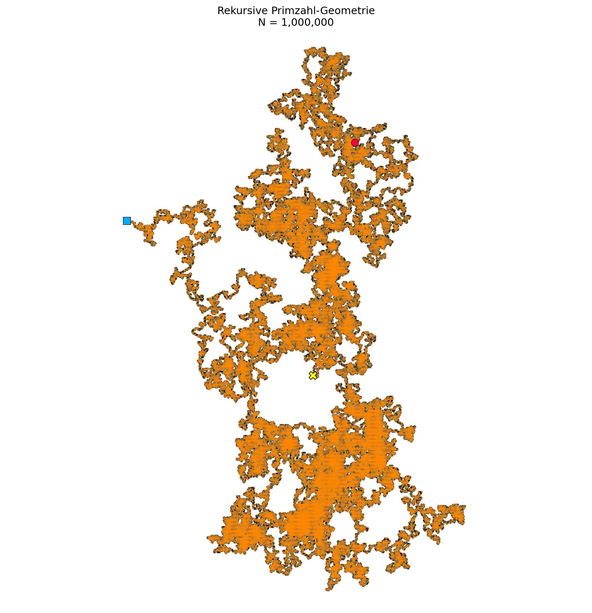
The black circular arcs represent prime-generated segments, while the colored circular arcs correspond to composite-generated segments. Prime numbers are labeled directly within the construction.
The red point marks the starting position of the construction.
The blue square marks the final position after all integers have been processed.
The yellow cross represents the centroid of the projected prime points. As additional prime numbers are encountered, this centroid shifts accordingly and gradually approaches a stable position.
The first figure (N = 500) illustrates the local construction in detail, making the individual circular arcs and prime labels clearly visible.
The second figure (N = 1,000,000) demonstrates the same deterministic rule after processing one million integers. At this scale, large-scale geometric structures emerge while preserving exactly the same local construction rule.
These visualizations investigate how a simple deterministic distinction between prime and composite numbers can generate increasingly complex geometric structures.
They are intended as computational explorations and do not claim a new theorem, a new primality test, or a mathematical proof concerning the distribution of prime numbers.