
CC BY-NC-SA-4.0

You are free to:

Share — copy and redistribute the material in any medium or format
Adapt — remix, transform, and build upon the material
The licensor cannot revoke these freedoms as long as you follow the license terms.

Under the following terms:

Attribution — You must give appropriate credit, provide a link to the license, and indicate if changes were made. You may do so in any reasonable manner, but not in any way that suggests the licensor endorses you or your use.
NonCommercial — You may not use the material for commercial purposes.
ShareAlike — If you remix, transform, or build upon the material, you must distribute your contributions under the same license as the original.

More information (license deed): https://creativecommons.org/licenses/by-nc-sa/4.0/

Earth grid models

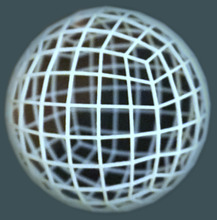
Even with the fastest supercomputers, we cannot fully model all climate processes in all regions of the world. Therefore, we divide the world into small grid cells and calculate the climate processes for these cells in parallel. The size of the cells is called the resolution of the grid. A common resolution is 100 square kilometers of Earth’s surface per cell.

Icon: 
Comic: We need to talk, AI

Yes, let’s talk. About the foundation of my technology and the opportunities I bring to society. But also about the risks — and how we sometimes misunderstand each other. In which areas is artificial intelligence already helping people? Do you know of any areas in which artificial intelligence is yet to be introduced or should be more prominent? What risks do new technologies pose that worry you?

Fibrés de Higgs sans géométrie

Les fibrés de Higgs sont apparus il y a quelques décennies comme solutions de certaines équations en physique, et ils ont attiré beaucoup d’attention en géométrie comme dans d’autres domaines des mathématiques et de la physique. Ici, nous donnons un aperçu très informel de quelques aspects d’algèbre linéaire qui anticipent la structure profonde de l’espace de modules des fibrés de Higgs.

La La Lab - The Mathematics of Music

We describe a journey through our exhibition La La Lab - the Mathematics of Music, which mixes a laboratory format with interactive exhibits to present visitors with the historical, conceptual, and artistic connections between mathematics and music, pushing forward musical creativity, mathematical knowledge and any blending of the two.

Deep Learning and Inverse Problems

Big data and deep learning are modern buzz words which presently infiltrate all fields of science and technology. These new concepts are impressive in terms of the stunning results they achieve for a large variety of applications. However, the theoretical justification for their success is still very limited. In this snapshot, we highlight some of the very recent mathematical results that are the beginnings of a solid theoretical foundation for the subject.

Linear Algebra III - part B

This digital publication is availbale in German and contains the unfinished last parts of lecture notes to a course given by Egbert Brieskorn in the 1980s at the University of Bonn, edited from the Nachlass. In these lectures Brieskorn merged modern presentations of Linear Algebra with topics of classical geometry more closely than usual at the time and probably also today. The central subjects of the present volume are the Theory of Polyhedra and Geometrical Crystallography.

Pages