3D fractal trip - Far away...
Submitted by Jeremie Brunet on
Pseudo-kleinian fractal animation made with Mandelbulb3D. Thanks to Jesse for the awesome program and Kali and Dark-beam for the formulas ideas and scripts.
This license is the most restrictive of our six main licenses, only allowing others to download your works and share them with others as long as they credit you, but they can’t change them in any way or use them commercially.
Submitted by Jeremie Brunet on
Pseudo-kleinian fractal animation made with Mandelbulb3D. Thanks to Jesse for the awesome program and Kali and Dark-beam for the formulas ideas and scripts.
Submitted by Jeremie Brunet on
3D fractal trip made with Mandelbulb3D
Submitted by Jeremie Brunet on
3D fractal trip made with Mandelbulb3D
Submitted by Jeremie Brunet on
3D fractal trip made with Mandelbulb3D
Submitted by Ester Dalvit on
A journey through the mathematical theory of braids.
Submitted by Jos Leys on
A two hour film on dynamical systems: see www.chaos-math.org
Submitted by Margarida Oliveira on
Relationship between mathematics and astronomy goes back in time. An analysis, though superficial, of a few episodes in the history of Mathematics shows how this science is actually fundamental to the progress of the different branches of knowledge.
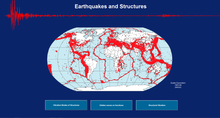
Every year several earthquakes occur on planet Earth with severe loss of human lives. During an earthquake most of us already experienced the vibrations at the Earth’s surface due to the propagation of the seismic waves along the crust. The main question we intend to answer with this project is: How do the seismic vibrations affect the civil engineering structures like bridges, dams or buildings?
Submitted by Guillaume Jouvet on
Alpine glaciers have been shrinking for more than one century. This trend is expected to continue if the global warming progresses. This film shows how mathematicians and glaciologists work together to produce realistic estimates of the future evolution of glaciers.
Submitted by Christine Leininger on
One of the main goals of wave propagation numerical modeling is to describe some earthquake phenomena as close as possible. The role of numerical wave propagation simulations is not to predict when and where there will be an earthquake, but to determine the strength and the trajectory of the seismic waves, depending on where the earthquake occur. It is important to know the less exposed areas, in order to plan the locations of new buildings. Similarly, it is crucial for the authorities to know where to house the victims of an earthquake to protect them from aftershocks.