Beat Box
Select an animation, press the “play” button and experiment with the parameters. Try to clap along.
Icon:


Select an animation, press the “play” button and experiment with the parameters. Try to clap along.
Turn the wheel and get the colored dots moving. Listen carefully.

Insert new nodes and connect them. Change the corresponding sound by clicking on the node and select a new note from the scale. Define the note’s duration and apply the different embellishments. You can hear the results in real time.
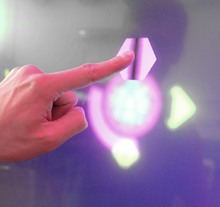
Take the role of a conductor. Move your hand over the sensor on the desk and play with the volume and speed of the piece you hear. Move the slider to get support from our Artificial Intelligence (AI) musician.
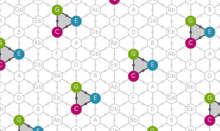
Explore how we can represent the notes in a logical and useful way! The Tonnetz is a pictorial representation of the notes in the plane that reveal affinities and structures between notes and on concrete music pieces.
Which sounds can be called “notes”, and used to create music? This exhibit is an experimental platform to explore the characteristics of sound and scales.
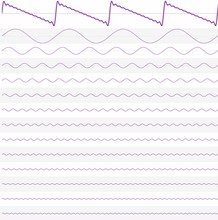
Sound and its perception has a rich mathematical structure that allows us to understand and create sounds by mixing waves. The Spectrum of Sound is an exhibit composed of two parts: a synthesizer and an analyzer. This is the Synthesizer part.
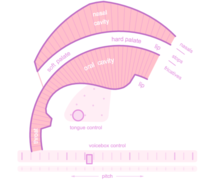
Pink trombone is a model of the human vocal tract that synthesizes human voice from scratch, controllable with your fingers.
Submitted by Ulrich Seidel on
Thomas M. J. Schäfer composed a permutative canon for 3 voices, 30 bars and 300 seconds. The graphical score has the shape of an equilateral triangle. The canon theme consists of 10 bars. The three voices have to pause sometimes for one or more bars when the theme was played. The beginning tonality is shifted, the permutations lead to dissonances and modern impression. Baroque and modern spirit are linked by romantic phrasing. The canon refers to the name, the oeuvre and the contrapuntal execution of J. S. Bach.
Submitted by Gerhard Widmer on
Gerhard Widmer on Expressive Music Performance, the Boesendorfer CEUS, and a MIDI Theremin