Dirichlet Series
Enviado por IMAGINARY el
Mathematicians are very interested in prime numbers. In this snapshot, we will discuss some problems concerning the distribution of primes and introduce some special infinite series in order to study them.

This license lets others remix, tweak, and build upon your work non-commercially, as long as they credit you and license their new creations under the identical terms.
More information (license deed): http://creativecommons.org/licenses/by-nc-sa/3.0/
Enviado por IMAGINARY el
Mathematicians are very interested in prime numbers. In this snapshot, we will discuss some problems concerning the distribution of primes and introduce some special infinite series in order to study them.
Enviado por Aubin Arroyo el
Nudos Salvajes, formados por la reflexiones en las esferas de un collar anudado.
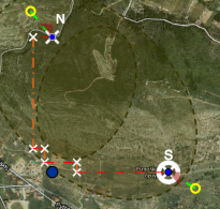
Description of Hero´s method that probably was used for Samos tunnel digging
Enviado por Francisco Javie... el
A classical problem proposed by Galileo.
Enviado por GeometrieWerkstatt el
This 3D print shows the Lawson surface which is the only known example of a minimal surface of genus 2, i. e., with 2 holes, in the 3-dimensional sphere.
Enviado por Juan Bragado Ro... el
Experiments on minimal surfaces in two and three dimensions
Enviado por IMAGINARY el
The algebraic geometer Duco van Straten, Johannes Gutenberg-University Mainz, Germany gives a beautiful short introduction into the field of algebraic geometry - from lines, curves to cusps. It shows many pictures and also links its content to historical events and applications.
Enviado por Brunda Alagarsamy el
Identification of Loops in SUZHI Kolam Pattern.Procedure for Identification loops given. This activity increases ones concentration power.
Interactive viewer for constant mean curvature and constrained Willmore surfaces.
Enviado por José Francisco ... el
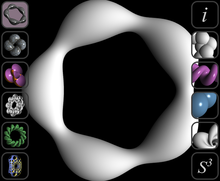
AnimaSurfer is an artistic animation made for the Formas & Fórmulas exhibition (Portugal 2012 - 2013).