HyperRogue
HyperRogue — playing with hyperbolic geometry
Icon:
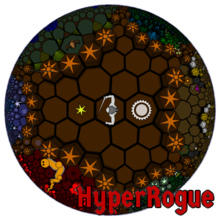

HyperRogue — playing with hyperbolic geometry
Submitted by Bernat Espigulé on
Plug a USB webcam, open an app like Photo Booth or Chrome’s Webcam Toy, enable the mirror effect, and then point your webcam to the screen. What do you see? The images get trap in a fractal attractor that you have just created by closing the video-feedback loop! The camera roll angle acts as the argument of the complex number and the distance from the camera to the screen acts as its modulus. Isn’t it wonderful? Have fun exploring this space of fractals that live in the complex plane.
Submitted by Charles Gunn on
The story of how Mercator’s world map of 1569 had important consequences for mathematics.
Submitted by Jérémy Bonvoisin on
The “ball-sorting machine” is a work-in-progress concept of a purely mechanical machine capable of sorting balls by weight order using a selection of sorting algorithms.
Submitted by Liubov Tupikina on
Here I add figures and plots I did with networks with my colleagues working on various projects on networks theory and application for data analysis.
Submitted by Francesca Iezzi on
Maths Week at work is a series of brief videos, aimed at showing to our teenagers the beauty and applicability of Mathematics, as well as the range of careers this discipline can open up.
Submitted by Torsten Stier on
An animated 3d fractal music video
Submitted by Aubin Arroyo on
Matemáticas Visibles
Why is the music scale irregular? Why are there black and white keys in the piano, distributed in such a peculiar pattern? Why do we have a scale with tones and semitones? And more deeply, how notes are grouped into families, and what role do they play within such families?

Sing into the microphone and move the synthesizer sliders to hear and see shifting chords.