All manner of Arches
The 17th-century scientist, engineer, architect, and Renaissance man Robert Hooke gave, on page 31 of his book A description of helioscopes and some other instruments, an anagram for the true Mathematical and Mechanichal form of all manner of Arches for Building:
Ut pendet continuum flexile, sic stabit contiguum rigidum inversum
(As the flexible line hangs, so shall the rigid blocks of an arch stand, inverted).
We tested Hooke’s recipe by 3D-printing models of a Gothic arch and of arches in the form of an ellipse, a parabola, and a catenary curve. You can watch videos demonstrating the stability of the models and make your own models using the attached STL files!
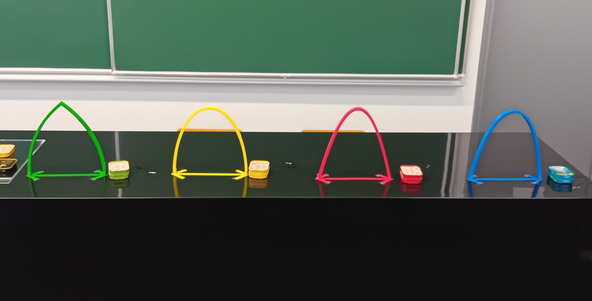
3D-printed models of arches
Our arch models have the same span, cross-section, centreline length, and number of sections/blocks. Each model has a hole through its centre, into which a thread can be inserted and tightened to compress the blocks together. Will the models remain standing when the thread is released?
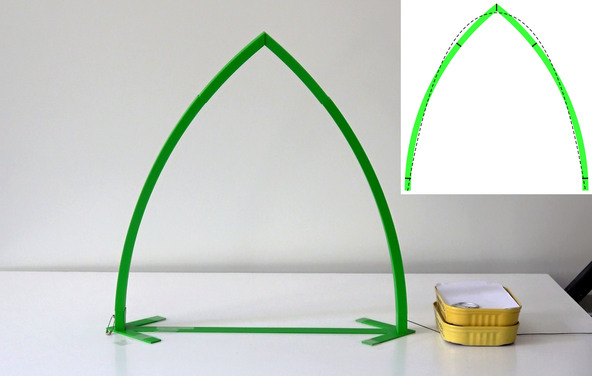
Fórmula
- $y=\sqrt{h^2+\frac{\left(d^2-h^2\right)}{d}|x|-x^2}$
Gothic arch
Video: http://youtu.be/KyfxZCavE30
The dashed line in the upper right-hand corner is a catenary of the same length, representing the line of thrust. In the formula, h denotes the height and d the half-span of the arch.
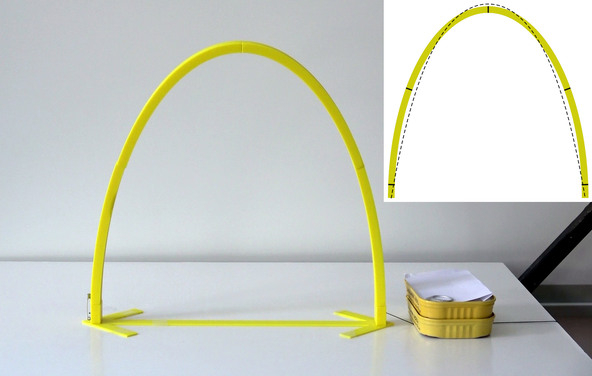
Fórmula
- $y=h \sqrt{1-\frac{x^2}{d^2}}$
Elliptical arch
Video: http://youtu.be/bBteQVs9h-A
The ellipse is slightly wider and lower than the catenary of the same length and span. Watch the video in slow motion and observe how the model collapses.
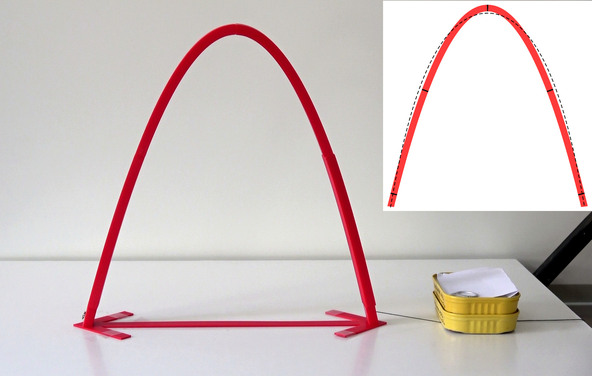
Fórmula
- $y=h \biggl( 1-\frac{x^2}{d^2} \biggr)$
Parabolic arch
Video: http://youtu.be/yx4LM_sPM-k
The parabola is slightly thinner and higher than the corresponding catenary. Can you identify the relationship between the way the line of thrust leaves the profile of the arch and the way the model collapses?
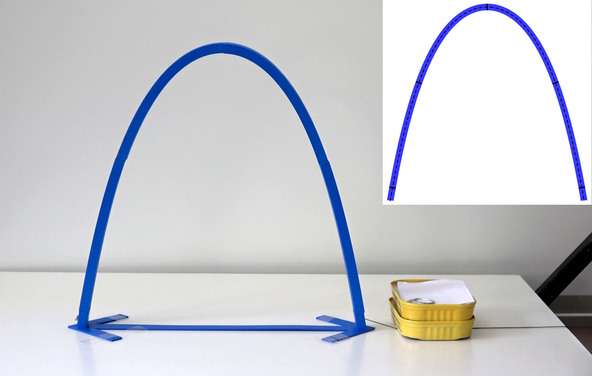
Fórmula
- $y=h+a -a \cosh \biggl(\frac{x}{a}\biggr),\quad a \cosh \biggl(\frac{d}{a}\biggr)=h+a$
Catenary arch
Video: http://youtu.be/bcqiFVuk0l0
The catenary arch remains standing even when the thread is loosened, as Hooke predicted! This experiment shows why the catenary is the ideal shape of a self-supporting arch under its own weight.