Large Geometric Construction of Cardboard
Submitted by George Hart on
A cool activity for making a giant mathematical construction by assembling cardboard components.
Submitted by George Hart on
A cool activity for making a giant mathematical construction by assembling cardboard components.
Submitted by Wizard Gynoid on
The E8 Polytope is an 8-dimensional object considered by mathematicians to be the most elegantly symmetrical and aesthetically pleasing geometric object known. Here we see 3D and 2D projections (shadows) of the 8D object. Of particular interest are the various symmetry axes, some of which display icosahedral, hexahedral and octahedral symmetries. The vertical symmetry axis resolves into the familiar concentric circles graph, with an unobstructed tunnel running through the complex object.
Submitted by michael jantzen on
Super Symmetry is a series of my digital photos that are derived from images of physical models that I make of my architectural designs. In most cases, the original image is manipulated with a computer (through the use of Photo Shop) in order to create a new image. Some times these new images are once again made into three dimensional structures, in an attempt to discover unexpected new forms. Often the new three dimensional forms are photographed once again in order to create more images. In every case, the objective is to create images that celebrate the beauty of complexity.
Submitted by Alan Singer on
This is a test of a color map using Cinderella software. I am interested in creating multi-color wave patterns.
I intend to use these color patterns to wrap complex 3D forms.
Submitted by Christian Gaier on
Christian Gaier creates colorful geometric-mathematical pictures and videos as hobby. He developed a set of mathematical functions to visualize basic geometric objects (line, circle and arc) in a surrounding colorful field. These functions can be easily combined to create more complex geometric structures. The main idea is that these functions deliver zero values at the position of the geometric object. Therefore, combinations of these functions can be easily realized by simple multiplications. The software units for picture computation are written in the programming language C.
Submitted by Kurt Ballay on
As a constructional engineer, born in 1944, I am self-taught in mathematics and art.
Submitted by Eleonore Faber on
This gallery contains visualizations of so-called free surfaces.
Freeness is an algebraic property, which is not so easy to explain: roughly, it means that a free surface has singular curves, which have a very “nice” algebraic structure (i. e., their defining ideal, the Jacobian ideal of the surface, is Cohen—Macaulay).
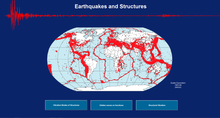
Dünyada her yıl çok sayıda insan hayatının sona ermesine sebebiyet veren birçok deprem gerçekleşiyor. Çoğumuz bir deprem sırasında yerkabuğu boyunca deprem dalgalarının yol açtığı sallanmaları hissetmişizdir. Bu projeyle cevaplanması beklenen soru ise şudur: Deprem dalgaları köprüler, binalar veya barajlar gibi yapıları nasıl etkiliyor?
Submitted by Bianca Violet on
Bu resimler SURFER’da üretildi. «Spektrum der Wissenschft» dergisinde SURFER haberini okuyup 2008’de SURFER yarışmasına katılarak bu muhteşem araçla yolculuğuma başladım.
Submitted by Jean Constant on
Series of visualizations based on a template created by mathematician Richard Kramer for a lecture on symmetry at the National Center for Genome Resources, Santa Fe, NM.