MathLapse Trailer
Submitted by Guillaume Jouvet on
Trailer for the first MathLapse Festival, held at the IC16 Conference in Berlin.
Submitted by Guillaume Jouvet on
Trailer for the first MathLapse Festival, held at the IC16 Conference in Berlin.
Submitted by Arnaud Chéritat on
An elegant 3D puzzle.
Put the 45 pieces back in the shell… and get an object that is the shadow of a hugely symmetric 4D object.
Submitted by Brunda Alagarsamy on
Lindermayer system is a parallel rewriting system and a type of formal grammar. It consists of an alphabet of symbols that can be used to make strings, a collection of production rules that expand each symbol into some larger string of symbols.
The recursive nature of L system rules leads to self similarity and thereby fractal like forms are easy to describe with an L system. This nature is applied in generating kolam pattern. Kolam pattern becomes more complex by increasing the iteration level.
Software: Python Turtle Graphics
Submitted by Atractor on
This MathLapse illustrates a process for constructing a stamp for imprinting a rosette which has (only) rotation symmetry.
Submitted by Atractor on
This MathLapse illustrates a process for constructing a stamp for imprinting a frieze which has (only) translation symmetry.
Submitted by Brunda Alagarsamy on
In the art form of SUZHI KOLAM/ KAMBI KOLAM, dots called pulli are arranged in rhombic, square, triangular, or free shapes, and a single, uninterrupted linear or curvilinear line, called the kambi, intertwines the dots.
L-System
Lindermayer system is a parallel rewriting system and a type of formal grammar. It consists of an alphabet of symbols that can be used to make strings, a collection of production rules that expand each symbol into some larger string of symbols.
The recursive nature of L system rules leads to self similarity and thereby fractal like forms are easy to describe with an L system. This nature is applied in generating kolam pattern. Kolam pattern becomes more complex by increasing the iteration level.
Software: Python Turtle Graphics
Submitted by Riccardo Moschetti on
A wonderful way to describe natural shapes using the language of mathematics is provided by self-similar patterns. The idea is to repeat the same base module on different scales and positions, following an iterative process that gives rise to very complicated and amazing results. By iterating the process infinitely many times one can often obtain a very interesting mathematical object: a fractal.
Submitted by Sylvain Faure on
A bidimensional simulation of a sphere moving at constant velocity into a cloud of smaller spherical grains. A dense granular “cluster” zone builds progressively around the moving sphere until a stationary regime appears with a constant upstream cluster size (when grains are far from any boundaries and without gravity).
The results are obtained from SCoPI software which implements a non-smooth contact dynamics method.
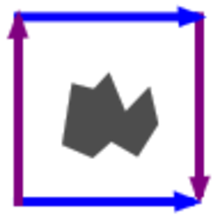
Genaster is a generalized asteroids game. The classic asteroids game glues the left screen edge with the right one and top edge with the bottom and therefore has a torus topology. This application considers other ways of gluing the screen edges.
Submitted by Christian Gaier on
The video shows the construction of a hypotrochoid.